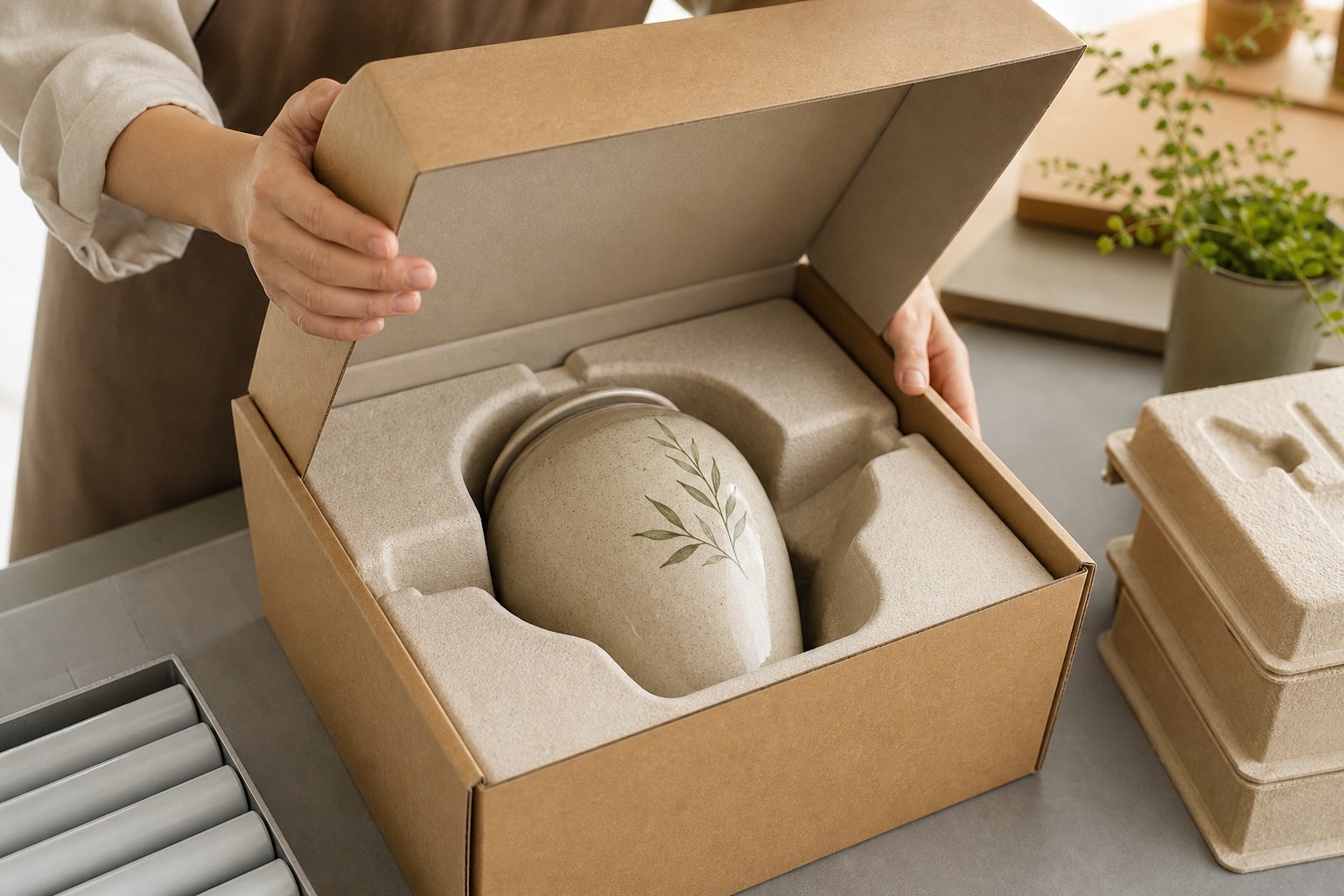
In most categories, packaging protects a product. In this one it also has to hold a family's worst week. A memorial parcel is opened once, by someone in grief, and everything about that opening — the color of the box, the sound of the tissue, the first line of the card — becomes part of the product. That is why private label packaging in the pet memorial category deserves more engineering attention than its price suggests, and why it is worth walking the full path from dieline to unboxing before you order your first custom run.
The four layers of a memorial parcel
Good memorial packaging separates two jobs that amateur packaging confuses: surviving the courier, and comforting the recipient. We structure every parcel in four layers, each with its own task and its own depth of customization.
| Layer | Job | Customization depth |
|---|---|---|
| Outer transit box | Survive the journey: double-wall board, no product imagery, neutral marks | Carton size, your shipping marks, courier labels |
| Inner gift box | Carry dignity: matte board, restrained color, your logo in deboss or foil | Full private label: structure, color, logo process |
| Protective insert | Hold the piece: foam cavity cut to the product's exact silhouette | Cavity shape per SKU; ribbon pull for lifting |
| Paper set | Speak once, kindly: condolence card, care card, memorial certificate | Wording, language, typography, your brand line |
The outer box answers to logistics; the inner three answer to emotion. For ceramic, crystal and stone pieces, the protective insert plus a double-wall outer carton is not an upgrade but our default: packing to pass a 125 cm drop test, the standard Amazon Seller Central requires for fragile items, so your marketplace compliance and your damage rate are solved by the same decision.
From dieline to doorstep: the actual process
- 1. Dieline and spec sheet. We issue the cutter guide for each box with material weights and tolerances; you place logos and text on it.
- 2. Artwork and tone review. Logo, color and — just as important — the wording of the condolence card, reviewed against your market's language and register.
- 3. Printed proof. A physical sample of box and cards, 7–12 days including product samples (3–5 days for engraved samples); nothing prints before you sign this.
- 4. Mass production. Boxes run alongside product; total lead time stays within the standard 20–35 days for most orders.
- 5. Line clearance and drop test. Packed cartons are checked against the packing standard, and fragile lines are packed to the 125 cm drop-test requirement before dispatch.
Ordering math follows the three MOQ tiers published on our OEM / ODM page: 100 pieces for stocked items with private-label touches, 500 for custom orders, 1,000 for deep customization such as new box structures. Packaging alone can often ride a smaller minimum than the product line — worth asking when you want to test a premium unboxing on your best-selling SKU first.
The compliance hiding inside packaging
Packaging is regulated goods, quietly. Three rules matter for our category:
- Solid-wood packaging (crates, wooden boxes) ships only after ISPM15 treatment with IPPC marks applied by a customs-approved facility — a condition of entry in most trading countries.
- Composite-wood components to the US — MDF or particleboard in box structures — fall under EPA TSCA Title VI formaldehyde limits (MDF at 0.11 ppm); compliant-panel documentation is listed on our materials and compliance page.
- Wood products to the EU come under EUDR due diligence from 2026-12-30 for large and medium operators and 2027-06-30 for micro and small ones; disclosing wood species and origin country on file helps you assemble the due-diligence statement, and FSC materials can support that process.
Private label packaging is the least expensive brand asset you will ever commission and the one your buyers remember most vividly. Start from the four layers, sign a real proof, and let the drop test and the paperwork carry the risk you cannot see — the unboxing will carry the rest.
FAQ
What MOQ applies to private-label packaging?
Our tiers are 100 pieces for stocked items with private-label touches, 500 for custom orders and 1,000 for deep customization such as new box structures. Packaging-only runs can often start smaller than the product line — ask per SKU.
Can the packaging meet Amazon's fragile-item requirements?
Yes. Ceramic, crystal and stone pieces are packed with individual foam cavities in double-wall cartons to pass the 125 cm drop test that Amazon Seller Central specifies for fragile goods — our default, not an option.
How much time does custom packaging add to an order?
Usually none: proofs are produced within the 7–12 day sampling window (engraved samples 3–5 days), and boxes run alongside production, keeping most orders within the 20–35 day lead time.
Can the cards and inserts be multilingual?
Yes. Condolence and care cards are produced per market language; keep each insert to a few short lines and review tone per market — restraint translates better than eloquence.
Sources & notes: Amazon Seller Central packaging requirements (fragile items, 125 cm drop test); China Customs public guidance on ISPM15/IPPC wood packaging marks; US EPA TSCA Title VI formaldehyde emission standards for composite wood (MDF limit 0.11 ppm); European Commission Access2Markets, EUDR application dates (2026-12-30 for large and medium operators; 2027-06-30 for micro and small). MOQ tiers, sampling and lead times follow PAWSANGEL's published service terms.
Want an unboxing your buyers remember?
Send your logo and market — we return a dieline set, card wording and a packaging quote with MOQ from 100 pcs within 12 business hours.