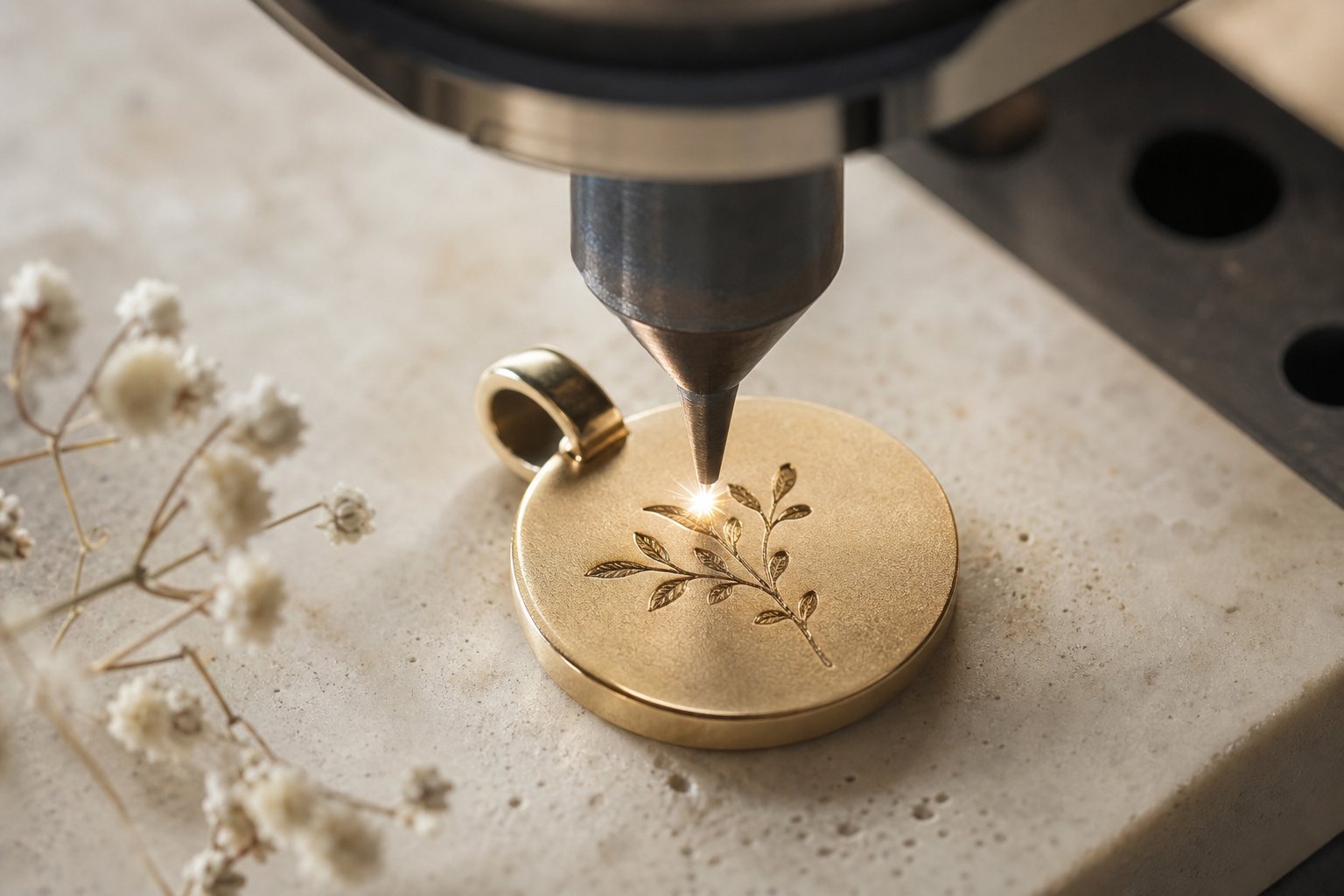
Engraving is the highest-leverage personalization in memorial goods — personalization is an explicit demand driver for the category (Grand View Research, 2025) — and most engraving rework traces back not to machine capability but to layout decisions made before the file reached the factory. A name set in the wrong font, a line that runs too wide for the engraving field, a message placed where a lid hinge crosses it: these are briefing failures, and they are preventable. This guide covers the four decisions that determine whether a layout survives production: font, line count, character budget, and placement.
Method and material: what each surface accepts
| Material | Preferred method | Typical minimum letter height | Notes |
|---|---|---|---|
| Wood (paulownia, walnut, oak, MDF) | Laser | ~5 mm | Burns to a warm brown contrast; grain direction affects fine strokes |
| Slate and granite | Laser | ~8 mm | Light gray-on-dark contrast; very fine serif strokes can wash out |
| Brass and stainless urns | Rotary or laser | ~4 mm | Crisp lines; hand-filled paint optional for higher contrast |
| Ceramic | Laser on unglazed base, or UV printing | ~6 mm (laser) | Photos and tone gradients route to UV printing instead |
| Crystal and glass | Sandblast or 3D inner laser; UV print | ~6 mm | Deep-etch text reads well; see our engraving vs. UV printing guide |
These are typical workshop values, not laboratory limits — every material batch has its quirks, which is why the proof-and-sample step exists.
Fonts: three families that survive production
- Serif (Times, Garamond class). The default for slate and granite; reads as classic and formal. Avoid ultra-thin serif variants at small sizes — hairline strokes fade on stone.
- Clean sans-serif (Helvetica, Lato class). Best for modern wooden boxes and metal urns; survives small sizes better than any other family.
- Script. Emotionally strong, technically fragile. Reserve for names only, at generous sizes, on wood and metal. On stone or crystal at small scale, connected strokes bridge and fill — the most common script failure.
Lines and character budgets
Two to three lines is the ceiling for keepsake-scale products; four lines fit only on plaques and large memorial stones. Long messages do not fail at engraving — they fail at readability, because letter height shrinks to fit the field. If the family's message runs long, brief it as two shorter lines and accept the product's physical limit rather than compressing text below legibility.
For mixed content, a workable budget: name up to 12–15 characters, dates in any format, message line up to 20–25 characters on standard urns and stones. Paw print and line-art motifs scale gracefully and often carry more feeling per square centimeter than a fourth line of text (workshop practice).
Placement zones by product
- Urns and boxes: front face, centered, upper-middle third. Keep clear of lid seams and hinges — text crossing a gap reads as a defect.
- Photo frames: lower rail, centered; or rear face for discreet personalization that does not compete with the photograph.
- Memorial stones: top face center for the primary inscription; edges and sides for secondary text, following the way the stone will be read at ground level.
- Figurines: base only. Never engrave the figure itself — the silhouette is the product.
- Jewelry: rear of pendants, 2–3 lines maximum at 1.5–2 mm letter height; front-face engraving only for monograms.
Workflow: proof, sample, production
Our sequence: layout proof for written approval (font, placement, exact spelling), then an engraved sample — 3–5 business days for engraved samples within our 7–12 day standard sampling window — then bulk production with the approved proof as the binding reference. Bulk lead time runs 20–35 days depending on process and quantity. Every downstream dispute about "the font looked different" resolves back to one document: the signed proof.
FAQ
How many characters fit on an urn?
On a standard front face with an 8–10 cm engraving field, plan roughly 15–20 characters per line at 6–8 mm letter height, three lines maximum. The proof confirms the exact fit for your text and chosen font.
Which font should I choose for a memorial?
Serif for stone, clean sans-serif for wood and metal, script only for short names on wood or metal at generous sizes. When in doubt, order the proof in two fonts and let the family-facing team choose — it costs nothing extra at proof stage.
Can you engrave a photograph?
On wood and slate, laser photo engraving in grayscale works well. On ceramic, crystal and glass, UV printing handles photographic content with better tone reproduction — the division of labor is covered in our engraving vs. UV printing comparison.
How fast is an engraved sample?
Engraved samples run 3–5 business days inside our standard 7–12 day sampling window; bulk production follows at 20–35 days depending on process and quantity.
Sources & notes: personalization as a category demand driver from Grand View Research (2025), grandviewresearch.com. Character budgets, letter heights and placement zones are workshop conventions of the engraving trade (industry practice); sampling and production lead times are PAWSANGEL published terms. The material-method table describes typical, not guaranteed, outcomes for each surface.
Have layouts to check? Send us your engraving fields
Share product and text; we return layout proofs with font and placement options, engraved samples in 3–5 business days — reply within 12 business hours.