At some point every growing buyer faces the same fork: keep putting your brand on proven stock bodies, or commission a mold of your own. The question presents itself as a branding decision. It is mostly arithmetic — and the arithmetic has a sequence. Work the numbers in the right order and the branding decision makes itself; work them in the wrong order and you will own a beautiful mold for a product nobody asked for.
The two paths, compared
| Dimension | Private label on stock | Custom mold |
|---|---|---|
| MOQ | From 100 pieces | From 1,000 pieces |
| Tooling cost | None | One-time mold fee, quoted per size and complexity |
| Sampling | 7–12 days (engrave-only samples 3–5 days) | Sculpting and mold-making add weeks before the first sample (magnitude, varies with shape) |
| Unit economics | Stock body price plus label and packaging | Body price plus amortized tooling line |
| Exclusivity | Open design others can also buy | Your shape, yours alone |
| Demand risk | Sits with the proven seller | Sits with you |
| Time to shelf | Fastest — stock-label goods can dispatch within 48 hours of payment | Slowest — sculpt, mold, sample, then production |
| Best stage | Testing a SKU, first orders, urgent replenishment | Hero SKUs with demonstrated sell-through |
The MOQ math, made explicit
Let the one-time mold fee be F. It is quoted per project — the magnitude moves with size, parting complexity and material (resin sculpt, ceramic form, wooden formwork), so treat any fee you hear second-hand as a placeholder until you have your own quote. At the 1,000-piece minimum, the tooling line adds F/1,000 to each unit. At 5,000 pieces, it adds F/5,000. Two structural conclusions follow, and they hold no matter what F turns out to be:
First, a mold only beats the stock-plus-label path once volume spreads the fee thin — which is exactly why deep customization starts at 1,000 pieces, not as an arbitrary gate but as the order of magnitude where amortization begins to behave. Second, the fee is a bet on demand you have not yet observed. That is why the sequence matters more than the fee: run the private-label version first, read the sell-through, then let the reorder curve — not the branding meeting — authorize the mold.
What private label actually includes
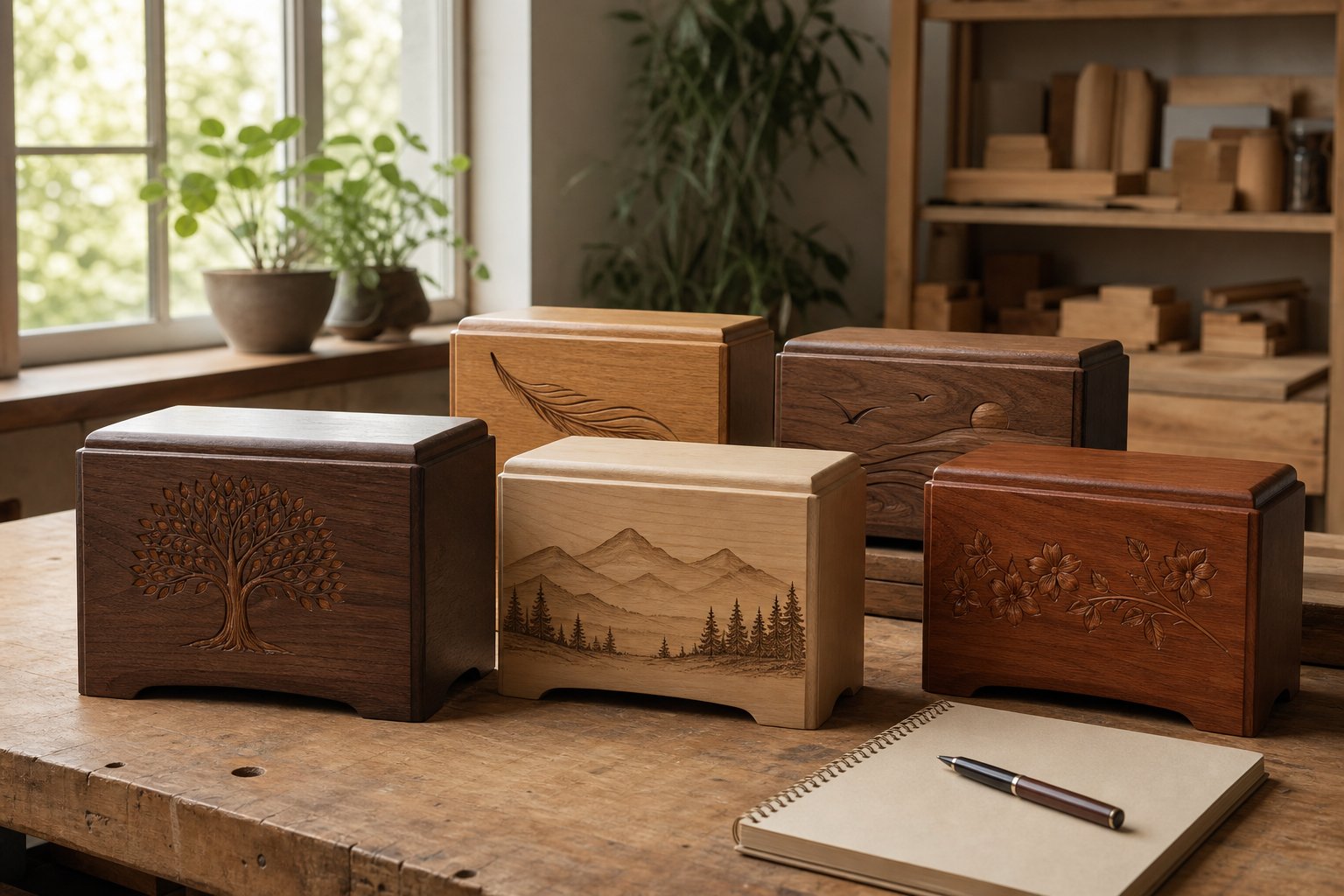
Private label is more than a sticker. On the lines we run it covers laser-engraved logos on wood and stone, branded hangtags, a gift box with a mourning card, and a memorial certificate — the full unboxing carries the brand, not just the product. This matters commercially: 360iResearch frames the memorial category in economy, mid-range and premium tiers (360iResearch, 2025), and packaging plus personalization are what move a SKU from one tier to the next without changing the product inside — see the OEM/ODM tiers for how the three engagement levels map to it. For urgent needs, stock-label goods dispatch within 48 hours of payment under our dropship terms — worth remembering because the purchase window after a pet's death is measured in days, and a mold cannot help you there.
When a mold earns its fee
A mold makes sense in four situations. One: a hero SKU where the shape itself is the brand and buyers recognize it at a glance. Two: shapes the open market does not stock — species-specific sculpts, garden markers, breed poses — where exclusivity is the selling point. Three: seasonal exclusives where timing beats cost. Four: intellectual property you intend to defend. In all four, the mold fee is buying differentiation, not unit-cost reduction; if your business case is purely about shaving cents per piece, a private-label negotiation usually gets there faster.
- Start at 100 pieces with private label; let the SKU earn its own evidence.
- Quote the mold fee against your real volume plan — F/1,000 and F/5,000 are different products economically.
- Keep the stock body as fallback while the mold is being made; the shelf never goes empty.
- Put mold ownership and storage terms in the PO — see the FAQ below.
FAQ
What order size is realistic for a first purchase?
For a first order, the private-label tier at 100 pieces on stock products is the realistic entry — it tests packaging, branding and demand without tooling exposure. Customization from 500 pieces and molds from 1,000 pieces come later, on evidence.
Who owns the mold afterwards?
Whatever the contract says — so say it clearly. Buyer-funded molds are commonly treated as buyer property, with storage, maintenance and usage terms written into the purchase agreement (industry practice). Get the terms in the PO, not in a handshake.
Can we move from private label to a mold gradually?
Yes, and that is the intended path: the private-label run generates the sell-through data, the sculpt and mock-up stage runs in parallel, and the stock body remains on sale until the custom shape is ready to replace it.
How is the tooling fee quoted?
Per project: size, parting complexity, material and finish all move the number. It is a one-time fee, amortized across your planned volume — so the same fee reads very differently at 1,000 and 5,000 pieces.
Sources & notes: MOQ tiers, sampling and dispatch terms follow PAWSANGEL commercial terms (private label from 100 pcs, customization from 500 pcs, deep customization from 1,000 pcs; sampling 7–12 days; stock-label dispatch within 48 hours of payment); three-tier category framework per 360iResearch pet memorial products report (2025); tooling process notes follow industry common practice.
Private label or custom mold — which side of the math are you on?
Send your volume plan — we run the MOQ math with you and quote both paths, reply within 12 business hours.