Ask ten craft factories for their minimum order quantity and you will get ten different numbers. That is not chaos. Each number is a precise statement about what it costs that particular workshop to set up a production run for you. Buyers who treat MOQ as a fixed wall tend to make one of two mistakes: they over-order to clear the bar and tie up cash in slow-moving stock, or they push the number down and later discover that the real cost arrived as quality shortcuts. Both outcomes are avoidable once you see the arithmetic behind the minimum.
What MOQ actually pays for, craft by craft
| Craft | Setup that drives the minimum | How flexible it usually is |
|---|---|---|
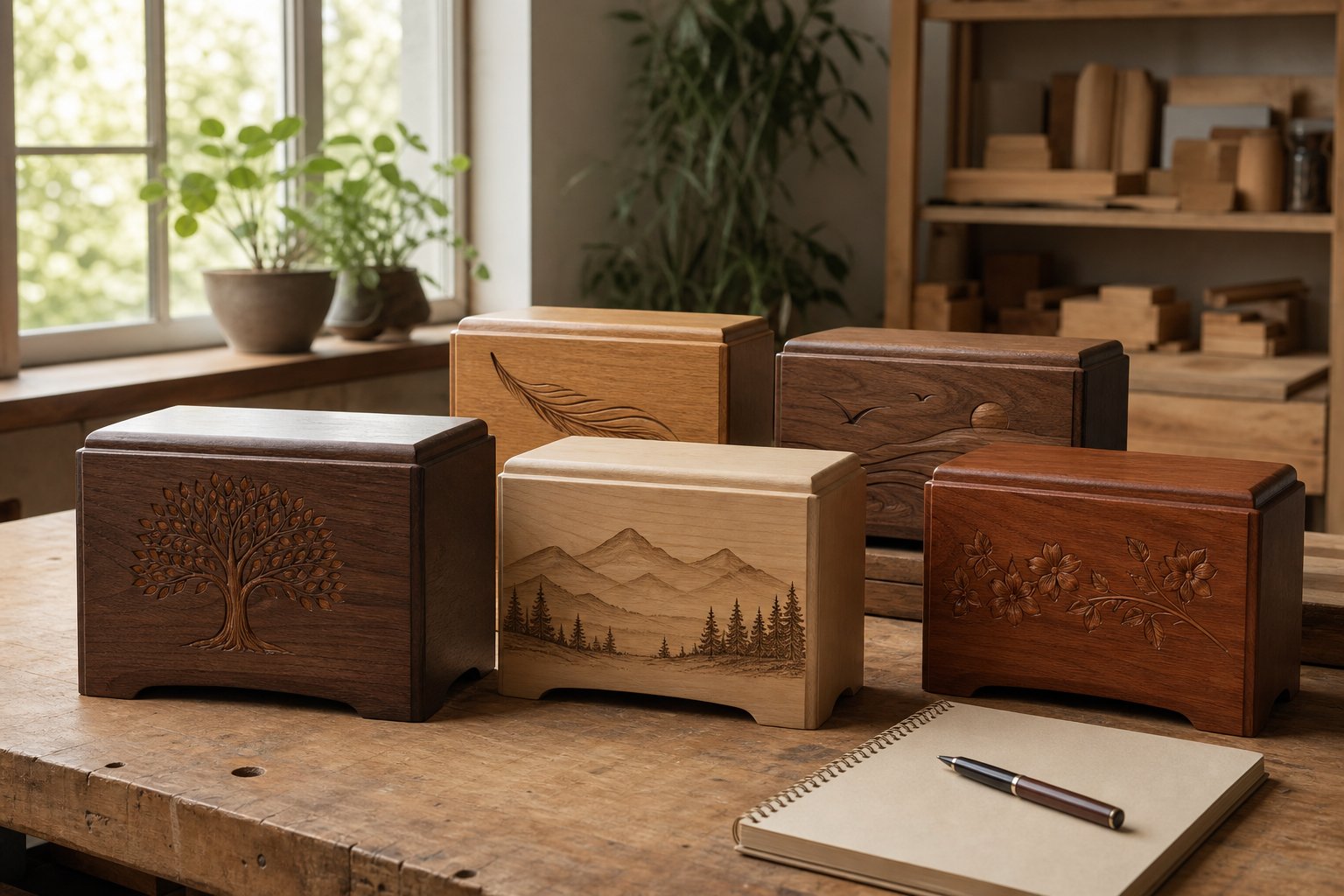
| Wooden boxes and caskets | Batch finishing: paint or stain lots, jig setup per shape | Medium - finish lot size is the lever |
| Ceramic urns | Mold opening and glaze toning; new shapes need new molds | Low on new molds; more flexible on existing bodies with a new glaze |
| Crystal and glass keepsakes | Blank stock per shape; 3D inner-carve programming per design | Medium on designs; low on brand-new shapes |
| Keepsake jewelry | Dies for stamped parts; plating-bath color minimums | High - assembly-driven, small setup per SKU |
| Willow and straw caskets | Hand weaving: dyed material lots and pattern setup | Medium - driven by material dye lots |
The table explains a pattern most buyers notice but few can name: keepsake jewelry is commonly listed on B2B platforms from single pieces, while wooden boxes and ceramic urns typically start from the low hundreds (industry observation, 2026). It is not that jewelry sellers are friendlier. Their setup per SKU is simply smaller, so their minimum can be smaller too.
Seven levers that actually move MOQ
- Mix SKUs inside one product family. Three urn designs sharing the same body, finish program and packaging often count toward one production run. Three unrelated crafts never do.
- Keep the body in stock, customize the surface. A standard box plus an engraved plate or laser-carved lid reaches private-label quality without touching the molding or finishing line. This is exactly how 100-piece stock private label works.
- Sample before you negotiate volume. A paid sample - 7-12 days on most lines, 3-5 days for engraved pieces - removes the factory's risk of quoting a smaller run blind, and it gives you a written quality baseline.
- Widen the delivery window. A factory can slot a smaller order into gaps between larger runs if the deadline is soft and the shipment goes by sea.
- Buy standard blanks, personalize later. Keeping engraving in-market or at the fulfillment step lets you hold one blank SKU and many end variants.
- Adjust price instead of volume. A smaller run at a modestly higher unit price often beats a larger run you cannot sell through. Ask for the price curve, not just the minimum.
- Commit in two steps. A smaller first bulk plus a scheduled repeat gives the factory forward visibility - which is what they actually want from a big number.
Where the 100 / 500 / 1,000 pattern comes from
Across the memorial-products trade, minimums cluster at three levels, and the pattern reflects setup economics rather than seller preference. Stock private label - your brand on existing bodies - starts around 100 pieces because the production line is already running. Customization such as engraving programs, color and lining changes sits around 500 pieces. Deep customization - new molds, new glaze colors, special shapes - sits at 1,000 pieces, because tooling and trial runs only recover their cost across a larger run. These are the tiers we publish, and industry practice across craft categories follows the same curve.
So when a factory refuses to move below a tier, ask what changed at the lower number. If the answer is "we would still have to open the mold," the minimum is honest. If the answer is "we never tried," there is usually a workable middle path: an existing body, a stock finish, a longer window.
Put the guardrails in writing
- A dimensioned spec sheet - capacity or size, material, finish, hardware - so the sample and the bulk match the same document.
- A packaging standard for fragile lines: individual foam cavities, double cartons, drop-test packing. Packaging agreed after production is packaging you pay extra for.
- A replacement policy covering quality issues and transit breakage, with spare units planned into the first order.
- The document list you will need at import: wood-origin disclosure for wooden goods, board emission reports for US-bound composite panels, material test reports for jewelry.
FAQ
Can I order below the listed MOQ?
Sometimes, at a per-unit premium or with reduced customization. The honest path is to ask what setup the minimum recovers; if your order can reuse an existing body and finish, many factories - including us on selected lines - will quote a trial quantity. Jewelry lines start lower than box lines by nature.
Why does deep customization need 1,000 pieces?
Because a new mold or a new glaze carries tooling and trial-run costs that only amortize across a larger run. Cutting the minimum without cutting the setup usually means the setup cost reappears in the unit price.
If I order three designs, does each need its own MOQ?
Designs that share a body, finish program and packaging can usually be aggregated toward one run. Designs across different crafts cannot, because they run on different lines with different setups.
Should I start with samples or a small bulk?
Always with samples - 7-12 days on most lines, 3-5 days for engraved pieces. A sample costs a fraction of a misjudged bulk order and becomes the quality reference the whole PO is checked against.
Sources & notes: MOQ tiers, sampling lead times (7-12 days; 3-5 days for engraved samples) and the spares/replacement policy reflect PAWSANGEL published service terms. The setup-cost framing (molds, glaze toning, plating baths, dye lots) reflects general manufacturing practice in craft industries. Platform MOQ ranges for jewelry and boxes are an industry observation, 2026, and vary by seller.
MOQ questions on a specific line? Send us your SKU list
We quote by tier with MOQ from 100 pieces, sampling in 7-12 days, and reply within 12 business hours.