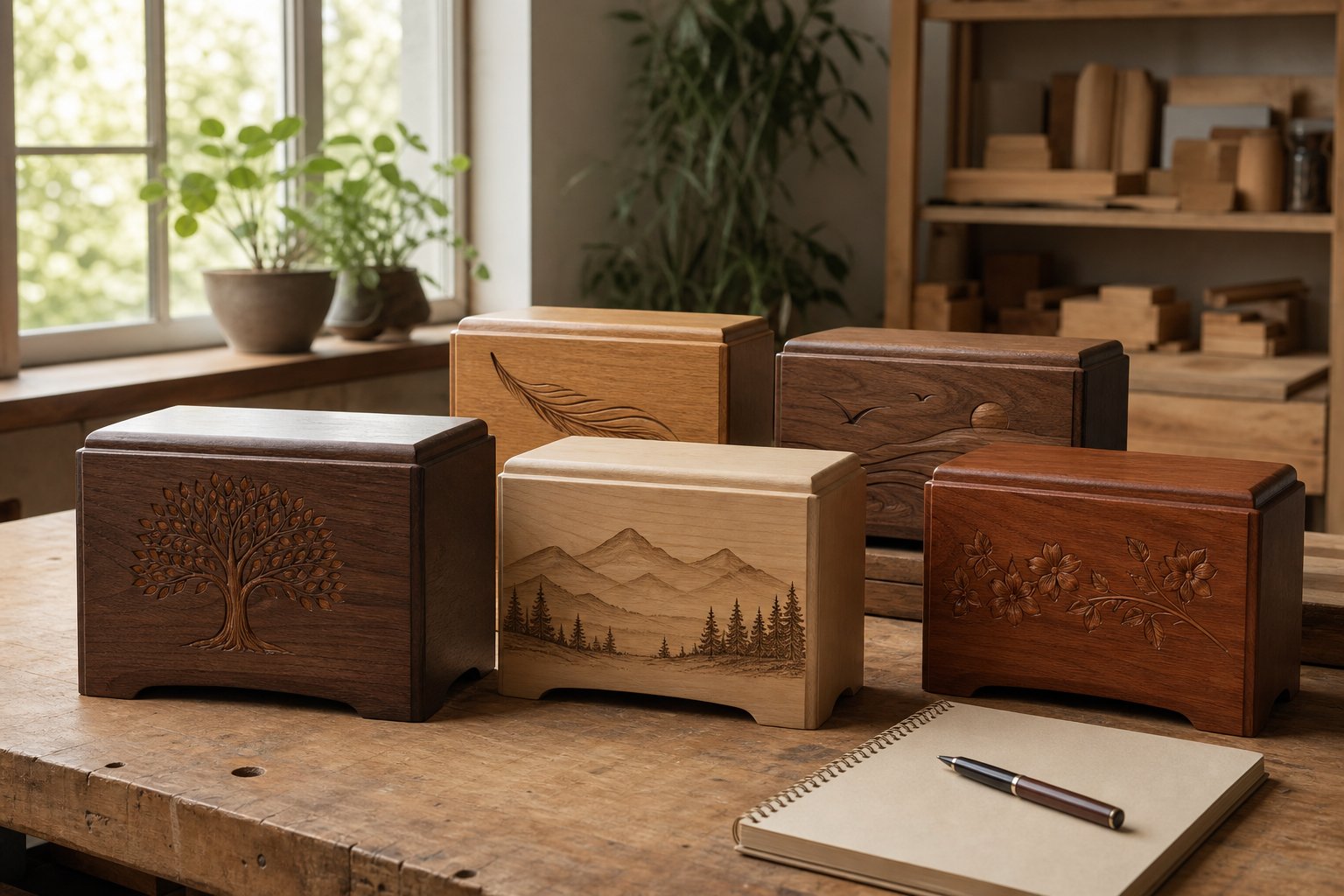
MOQ looks like a barrier and behaves like a pricing variable. The question is never "can I afford 100 pieces?" but "what does each piece cost me at 100, at 500, and at 1,000 — and what does it retail for against the service ticket my customer has just paid?" This article walks one real-shaped basket through the full calculation: a five-SKU wooden urn line for a US online seller, from FOB quote to retail margin. Every assumption is stated, so you can substitute your own numbers.
The worked example, line by line
Scenario: a US DTC seller builds a starter wooden urn line — three sizes plus two keepsake urns — ordering 100 pcs per SKU (500 pcs total) at the stock private-label tier. Assume a mid-range FOB of $6.00 per unit (within our $3–12 magnitude range for wooden urns, configuration-dependent), 1.2 kg gross weight per packed piece, and $3.50/kg air-freight for a small first order. These freight and weight figures are illustrative assumptions for the arithmetic, not quotations.
| Step | Calculation | Per unit |
|---|---|---|
| FOB cost | quoted at 100 pcs, stock private-label | $6.00 |
| Freight (air, small lot) | 1.2 kg × $3.50/kg | $4.20 |
| Duties and clearance | budget an allowance — rates vary by HS code and market; ask your broker | ~$0.60 (assumed) |
| Payment and handling | assume 2% on cost | ~$0.20 |
| Landed cost | FOB + freight + duties + handling | ~$11.00 |
| Retail anchor | basic urns start around $50 in the US market (CareCredit/Synchrony, 2023) | $49–59 typical |
| Gross margin | (retail − landed) ÷ retail, at $49 | ~78% |
Two readings of that last row. First, gross margin is genuinely high in this category — but freight nearly doubled the unit cost on a small air lot, which is why channel choice matters more here than in light-goods niches. Second, the high margin is not a gift; it funds the costs this table does not show: advertising, returns allowance, and the service burden of a grief-sensitive category (inference).
How the tiers change the math
| Tier | MOQ | Typical use | Effect on unit economics |
|---|---|---|---|
| Stock private label | 100 pcs | Test a market, launch a line, urgent replenishment (ships in 48 h) | Highest FOB within the range; freight per unit heavy on small lots |
| Customized | 500 pcs | Own colors, engravings, packaging on proven SKUs | FOB steps down within the range; sea freight becomes viable, cutting landed cost sharply |
| Deep custom | 1,000 pcs | New molds, sculpted forms, proprietary artwork | Tooling quoted per project; amortize it across the run — at 1,000 pcs a tooling fee spreads thin per unit |
The pattern: volume does not just lower the factory price — it unlocks cheaper freight (sea instead of air), which in this category often moves landed cost more than the FOB discount does. Buyers who negotiate only the FOB number leave the larger half of the savings untouched (inference).
Where the margin actually comes from
- The service ticket anchors willingness to pay. Families paying $100–450 for private cremation (CareCredit/Synchrony, 2023) evaluate a $50–90 memorial against the service, not against mass-market decor. A $50–120 memorial against that ticket is roughly 20–50% of the transaction — our inference from the published fee table.
- Position in three tiers, not one price. The memorial products market is structured into economy, mid-range and premium bands (360iResearch, 2025). A three-tier line captures both the budget-conscious vet clinic channel and premium hardwood buyers without repricing a single SKU.
- Keepsakes raise basket value at low MOQ. Keepsake jewelry starts at 50 pcs in our tiers — the cheapest inventory experiment in the category, and the easiest attach-on at checkout.
FAQ
Can I start below 100 pieces?
Yes — through samples for validation, or through our dropship program for stock lines, which fulfills per-order without inventory. The 100-piece tier is where private-label stock economics start; below that you are buying information, not goods.
How does engraving change the unit cost?
Engraving adds a per-piece processing step and, on first orders, a small setup that amortizes across the run. Within our quotes it is a modest, configuration-dependent addition — ask for engraved and non-engraved FOB quotes side by side to see the exact delta for your SKU.
What retail price should I target?
Anchor against the service: basic urns start around $50 in the US market (CareCredit/Synchrony, 2023), with the category's economy/mid-range/premium structure above it (360iResearch, 2025). Price your entry urn near the market's basic anchor and let materials and personalization carry the tiers above.
Should I buy FOB or DDP?
FOB makes supplier comparison clean; DDP bundles freight and duties into one number and hides variance. We quote FOB Shenzhen/Qingdao/Guangzhou as standard, with EXW and door-delivery negotiable — compare suppliers on FOB, then buy freight separately.
Sources & notes: US basic urn price anchor and cremation fee ranges from CareCredit/Synchrony (2023), carecredit.com; economy/mid-range/premium market structure from 360iResearch (2025), 360iresearch.com. MOQ tiers, lead times and 48-hour stock dispatch are PAWSANGEL published terms. All freight, duty and weight figures in the worked table are illustrative assumptions for the arithmetic, not quotations; the 20–50% ticket-share reading is our inference from the cited fee table. FOB ranges are magnitude ranges that vary with configuration.
Want this table filled with your numbers?
Send your target retail and market; we return FOB tiers by configuration and the landed-cost math to match — reply within 12 business hours.