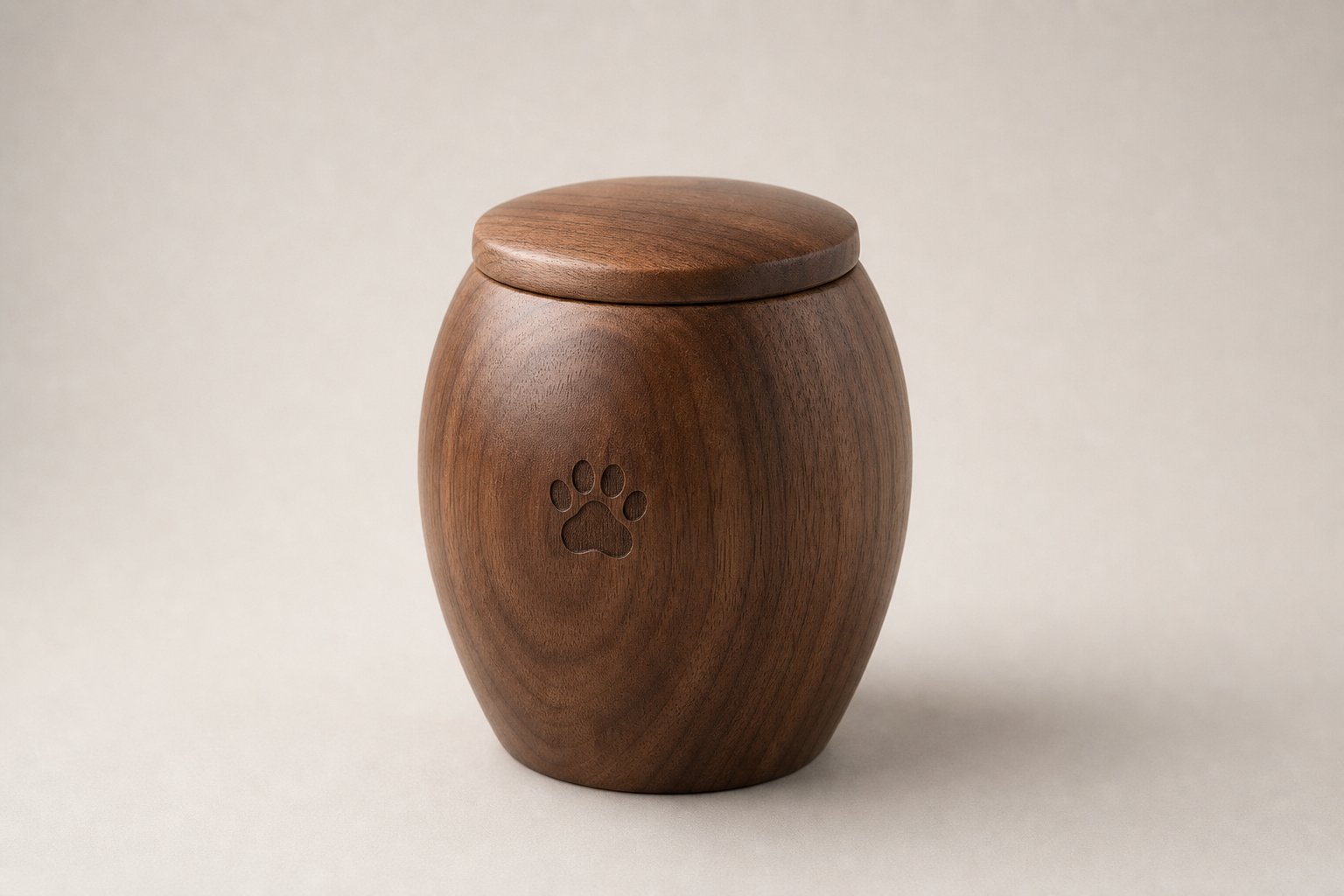
After the ashes come home, a quiet question follows: where should the urn live? For many families it is not a small one. Keeping a pet's remains at home is a widely accepted practice — consistent with how deeply these bonds run, with 97% of US pet owners describing their pets as family members (Pew Research Center, 2023) — and display choices follow that same bond. There is no universal rulebook, and this guide does not pretend to write one. What follows is the placement practice families commonly settle into, the material care that keeps an urn in good condition, and how retailers can guide buyers without prescribing.
Places that work, and why
| Placement | Why families choose it | Care considerations |
|---|---|---|
| Living room shelf or bookcase | Keeps the pet in the room where life happens; easy to greet daily | Stable surface, away from traffic lanes and passing drafts |
| Mantelpiece | A place of honor; visible from across the room | Watch heat from fireplaces and direct afternoon sun on wood finishes |
| A dedicated memorial corner | Urn, photo frame, candle and paw print together form a small place of remembrance | The most flexible option; grows over time with new pieces |
| Near the pet's favorite spot | The window sill, the bed, the garden door they watched from | Sills need sturdy support and sun protection for wood and printed finishes |
| Home office or study | Companionship during working hours, quietly in view | Keep clear of desk edges, cables and frequent reaching |
The placements that families usually come to regret are the practical rather than the symbolic ones: bathroom humidity, a laundry shelf that vibrates, a low table within reach of children or a curious new puppy, and narrow ledges where a passing sleeve can catch the urn. None of these are etiquette failures — they are material-care failures, and they are preventable at the moment of advice.
Material care across the range
Care guidance follows the material more than the room. Wooden urns prefer stable humidity and dislike prolonged direct sunlight, which fades finishes and can open seams over time; a shaded shelf suits them better than a sunlit sill. Ceramic and porcelain urns tolerate light and humidity better but are vulnerable to impact, which argues for height and stability rather than low traffic shelves. Metal urns are forgiving on both counts but show fingerprints, and resin pieces should stay away from radiators and strong sun that can warp them. Crystal keepsakes ask mainly for a stable base — their light stands and the stones themselves are heavier than they look.
None of this is complicated, and that is the point: a single care card per material, slipped into the box, prevents the two most common after-purchase disappointments — fading and chipping — which are among the recurring complaint patterns in the category (industry common practice).
Cultural context, briefly
Placement norms differ by market, and buyers serving several countries should know the spread. In Germany, several cities allow a pet's ashes to be buried together with their owner — Hamburg among them, as reported in 2019 (Deutsche Welle) — so home display there competes with a long-horizon option. In Japan, memorial customs are more formalized and product expectations follow them, which is one reason lightweight paulownia-wood formats suit that market. And in markets where keeping ashes at home is common, the "memorial corner" arrangement described above is the pattern that recurs. The respectful position for a retailer is the same everywhere: offer options and care information, never a doctrine.
Splitting the ashes, spreading the remembrance
One placement question hides another: who keeps the pet? Families with several members — or several households after a separation — often divide the ashes, keeping the main urn in the family home while mini keepsake urns or chamber pendants carry a portion to children, partners or a housebound relative. The urn sizing logic behind this is straightforward and covered in our urn size chart; the emotional logic is that no one has to give up the whole of the pet to share them. Retailers who present the main-urn-plus-keepsakes basket at the right moment serve the family better than any single-product pitch.
Merchandising the placement, honestly
- Photograph the urn in a real setting, with scale. A lifestyle image on a shelf beside a photo frame communicates true size — and measurably reduces "smaller than expected" returns, the category's recurring complaint pattern.
- Sell the corner, not just the box. Frame plus candle plus urn is a coherent gift and a coherent shelf; bundle them with neutral packaging.
- Put the care card in every box. One line per material — sun, humidity, stability — costs nothing and answers the placement question before it is asked.
FAQ
Is it OK to keep a pet's ashes at home?
Yes — it is a widely accepted and common practice, and the choice of whether and where to display remains entirely with the family. There is no obligation either to keep or to bury; both are legitimate ways to remember.
Where should I not put a pet urn?
The practical shortlist: humid bathrooms, unstable or vibrating surfaces, ledges within reach of children and pets, and prolonged direct sun for wooden and resin pieces. Material care, not etiquette, drives these limits.
Should the urn face a certain direction?
There is no universal rule; conventions differ by culture and religion, and most families simply choose the spot where they most naturally feel near the pet. Retailers should present placement as a choice, not a requirement.
Can ashes be split between several keepsakes?
Yes. A common arrangement keeps a main urn at home while mini urns or chamber pendants carry small portions to other family members. Divided chambers in wooden and ceramic urns are also a standard OEM option for two-pet households.
Sources & notes: Pew Research Center (2023) for the 97% family-membership figure (report); German co-burial practice as reported by Deutsche Welle (2019); placement patterns, material care and complaint patterns reflect industry common practice; product formats and OEM options follow PAWSANGEL product specifications.
Building an urn range with care cards and display-ready photos?
We supply wooden, ceramic and metal urns with per-material care cards and scene photography, MOQ from 100 pcs — reply within 12 business hours.