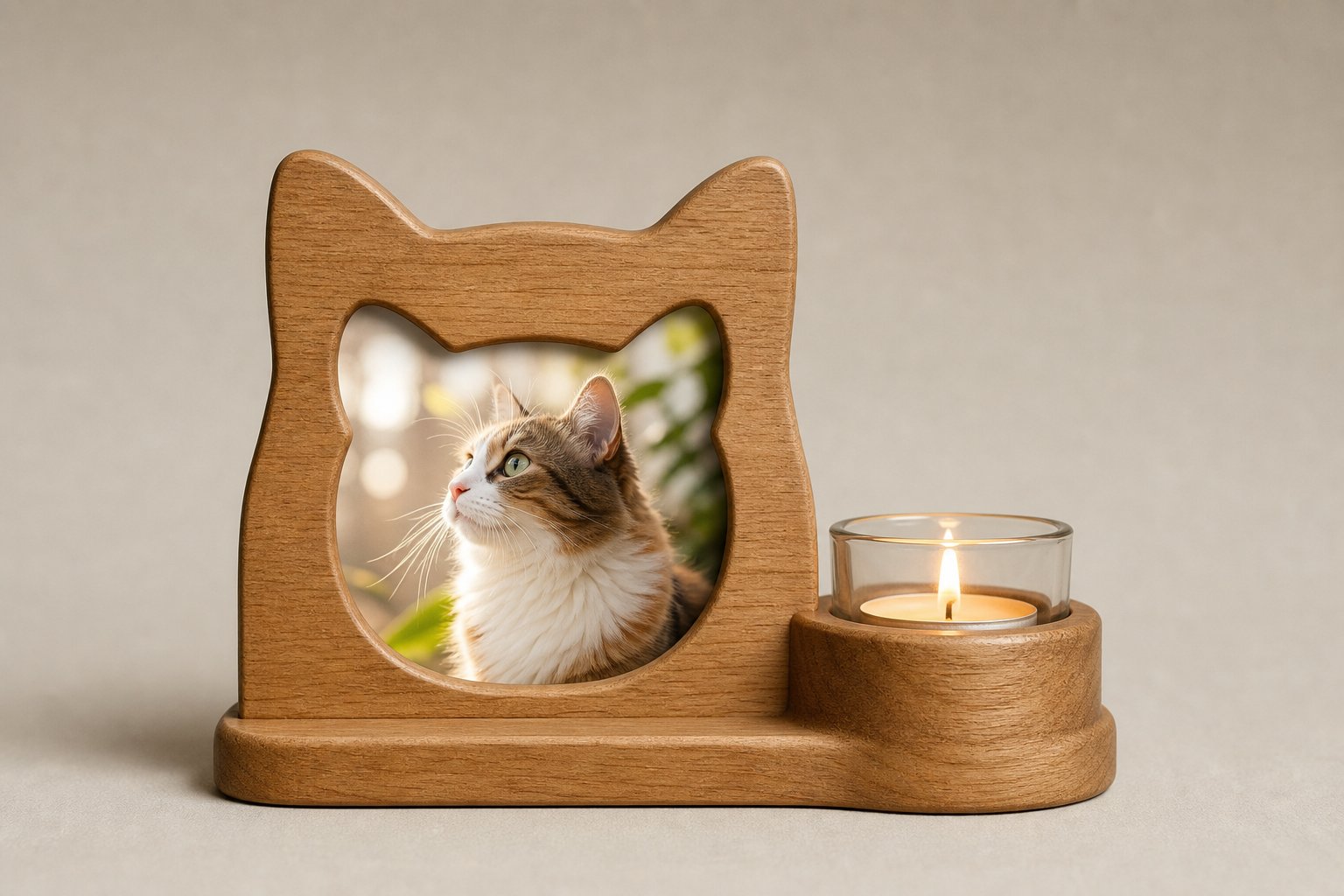
A memorial product photo carries two loads at once: it has to answer practical questions — how big, what material, where does engraving go — and it has to hold a respectful tone in a category where the buyer is grieving. Most listings in this category fail one of the two: either the photography is so sterile it could be a bolt, or so staged it feels like a greeting card. The fix is a repeatable shot list. Demand is real — "pet memorial" ranks among Etsy's top searches (eRank, Q3 2025, tool data) — but photography is what converts that demand.
The shot list, frame by frame
| Frame | What it answers | Notes |
|---|---|---|
| Hero (white or soft neutral) | What is it — form and material at a glance | Follow each marketplace's main-image rules; product centered, no clutter |
| Three-quarter detail | Craft quality — wood grain, glaze, joinery | Raking light across the surface reveals texture honestly |
| Scale reference | True size — the top pre-purchase doubt | Dimensioned line drawing plus a photo with a hand or everyday object; empty-table shots read larger than life |
| Engraving preview | Where my text goes, in what font | Show font, placement and a realistic character count; prevents most personalization disputes |
| Packaging | Is it gift-ready and protected | Gift box, protective cavity, plain outer carton — one frame, three messages |
| Scene | How it lives in a home or garden | Respectful staging — see the prop rules below |
Lighting and background
Soft, diffused light from one main direction, filled from the opposite side, does more for memorial products than any camera upgrade. Hard light cuts sharp shadows that read as harsh in a soft category. A light tent works for jewelry and keepsakes; larger urns and stones prefer a swept paper or linen background near a window.
For backgrounds, warm neutral tones — soft white, oat, sage, pale gray-blue — hold the category's quiet register. Two failure modes to avoid: pure-white-only galleries that flatten and chill, and dark moody sets that swallow detail on dark woods and slate. Mix one light set with one warmer scene set across the gallery.
Props: respectful by rule, not by taste
- Safe vocabulary: fresh or dried flowers, linen, wood, candles (unlit), collars, a favorite toy, a printed photograph. These read as remembrance.
- Never: skulls, Halloween styling, rain-on-window melancholy clichés, or anything that stages the pet's death. The category sells memory and gratitude, not gloom.
- Hands are allowed — a hand resting near or holding a keepsake communicates scale and care at once, and consistently outperforms sterile shots for keepsakes (industry practice).
- One prop family per frame. A collar and a flower tell one story; a collar, a flower, a candle, a leash and a toy tell five.
Engraving mockups and natural variation
If the product takes personalization, at least one frame must show it — the actual font and placement a buyer's text will occupy. Engraved examples convert better than a "customization available" badge, and they set letter-height expectations that prevent the "text is tiny" review. For glaze, stone and wood, photograph the natural range across two or three units and state variation in the listing; stone veining and glaze pooling are the honest truth of craft materials, and surprise is the enemy of reviews.
A minimal kit that is enough
- A phone with manual exposure control, on a tripod — consistency across a catalog matters more than sensor size.
- One diffused key light or a window plus a white foam-board fill.
- Swept paper or linen in two tones, a light tent for small pieces.
- A ruler or dimensioned drawing for the scale frame, and your real packaging for the pack shot.
FAQ
Do I need a professional camera?
No. A phone with manual controls on a tripod, one diffused light and consistent backgrounds will outperform an expensive camera used inconsistently. Buyers read coherence as professionalism.
How do I show the true size of an urn?
Combine a dimensioned line drawing with a lifestyle frame containing a familiar reference — a hand, a book, a side table. Empty-surface shots systematically make products read larger than they are, which drives "smaller than expected" reviews.
Can I use my supplier's photos?
Ask, and check exclusivity. If the factory serves other sellers, the same images will appear across competing listings. Request a licensed exclusive set or shoot your own six-frame list from samples.
How many photos should a listing have?
Six to nine. The six-frame minimum above, plus color or variant frames and, for personalized goods, a second engraving example. Beyond ten, added frames rarely add information (industry practice).
Sources & notes: Etsy search demand for "pet memorial" per eRank Q3 2025 rankings (tool data), help.erank.com. Shot list, lighting and prop guidance reflect industry practice in product photography for keepsake categories (inference/practice); wholesale image pack terms are PAWSANGEL's own offering. Marketplace main-image rules vary by platform — follow each platform's current seller documentation.
Need photos for your listings?
Ask about our wholesale image packs — six-frame sets per SKU with scene shots you can license — reply within 12 business hours.