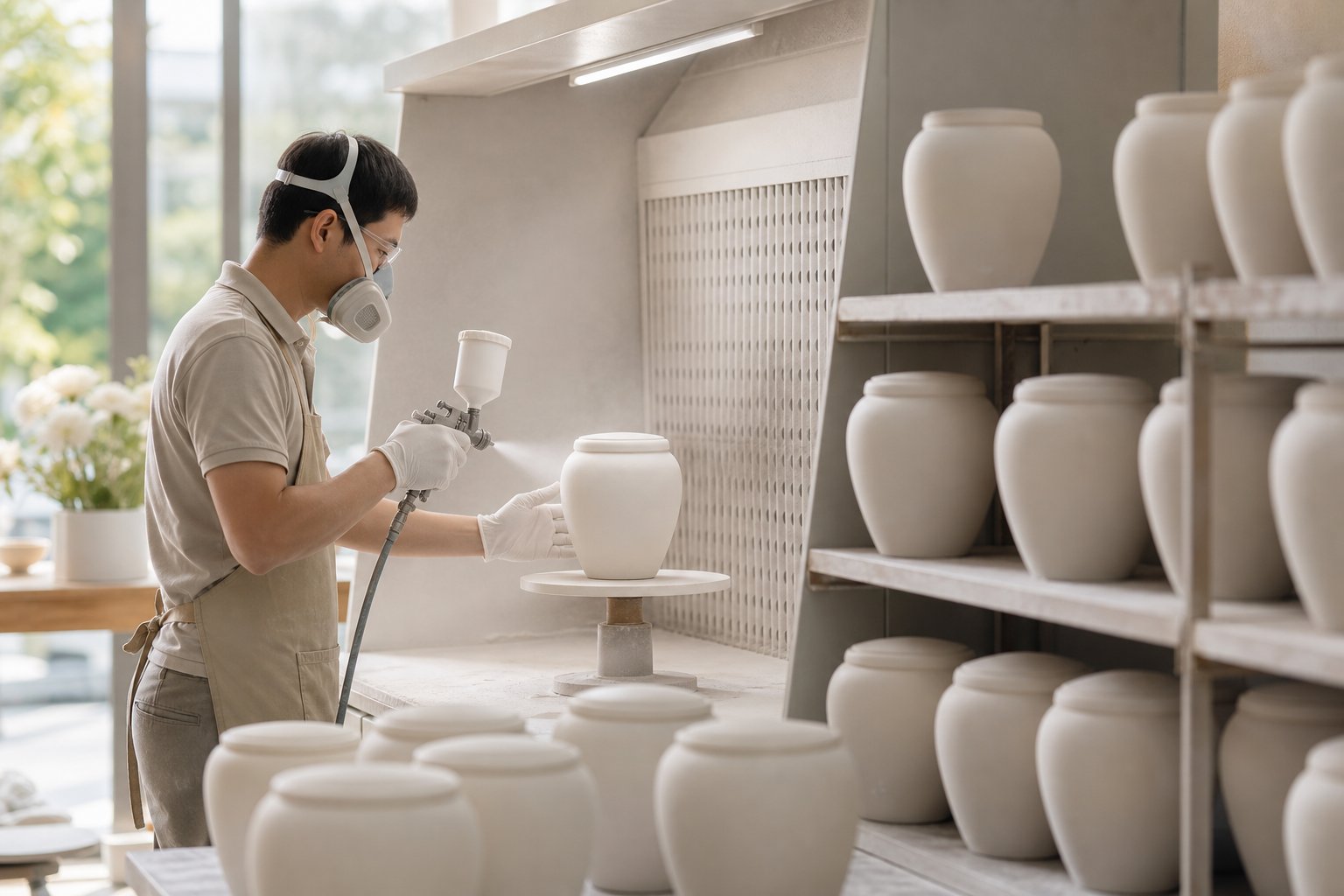
Ceramic is the material customers reach for when the memorial should feel permanent: cool to the touch, substantial in the hand, glazed in colors wood and resin cannot hold. Sourced well, it is also one of the most defensible margin structures in the category. And there is effectively one place to source it at depth: Jingdezhen in Jiangxi province, the porcelain capital whose workshops have fired high-temperature ceramics for centuries, with Chaozhou in Guangdong as the export-volume counterpart to the south.
Why Jingdezhen anchors ceramic urns
Jingdezhen's advantage is not one factory but a full ecology: kilns that reach high-fire temperatures, studios that mix and match glazes the way paint mixers match colors, hand-painters who can execute a paw portrait in underglaze style, and mold shops that move a new shape from drawing to sample. Domestic marketplaces list ceramic pet urns overwhelmingly from Jingdezhen-based sellers - a qualitative observation, but a consistent one - and the craft behind those listings is the same heritage that made the city's porcelain collected worldwide.
For a buyer, the practical meaning is this: when a customer asks for a specific glaze tone, a hand-painted likeness, or an unusual silhouette, Jingdezhen is where the answer is a sampling conversation rather than a refusal.
Jingdezhen or Chaozhou: which cluster for which order
Both cities are ceramic centers, and mature buyers use them for different jobs. Chaozhou's Fengxi district is a global center of daily-use ceramics production and export, home to more than 5,000 ceramics and supporting enterprises with annual output above RMB 50 billion (China Overseas Chinese Network, 2019). That machinery is built for high-volume, export-priced tableware and giftware - and it is the right engine when the program is large, standardized and price-led.
| Dimension | Jingdezhen (Jiangxi) | Chaozhou / Fengxi (Guangdong) |
|---|---|---|
| Core strength | Art porcelain: glaze depth, hand painting, special shapes | Export volume: standardized bodies, sharp pricing, scale |
| Best-fit programs | Personalized urns, limited glazes, portrait decoration | Wide-breadth catalog at entry-to-mid price points |
| Customization posture | Glaze toning and hand-paint are native studio work | Decal and print driven; glaze changes need bigger runs |
| Lead-time character | Longer on custom decoration; worth the wait on premium lines | Shorter on standard bodies at volume |
Our own ceramic-resin urn line draws on both: high-fired ceramic bodies for the round, heart and special shapes that carry the line's premium tier, and resin for shapes where weight or breakage economics favor it.
What to specify before you sample
- Body. High-fired ceramic for permanence and glaze depth; resin where weight, cost or drop-risk management dominates. The two are often mixed in one catalog and should be labeled honestly.
- Capacity. Size the urn to the weight tiers your customers actually serve; a ceramic urn that cannot hold a 30 kg dog's ashes is a return in waiting.
- Glaze. Choose from existing studio glazes for the fastest path, or budget a toning run for a proprietary color - new glazes are trial-and-error work by nature and belong in the customization tier, not the stock tier.
- Decoration. Hand painting for portraits and one-off artistry; decals for repeatable graphic motifs at scale; laser engraving belongs on the wood base or lid, not the glaze.
- Base and fit. Most ceramic urns sit in a wooden lid or base - confirm the fit tolerance in the sample, because glaze thickness varies run to run.
MOQ and lead times
Our ceramic-resin urn line runs on MOQ 200 pieces with FOB pricing in the USD 2.5-9 band depending on size, body and decoration (indicative band, varies with configuration). Standard bodies with catalog glazes sample in 7-12 days; hand-painted and toned-glaze programs sit at the longer end of our 20-35 day bulk window because each firing batch needs its own care. That timeline is the honest price of a product that cannot be "reprinted" the way a decal can.
FAQ
High-fired ceramic or resin - which should I stock?
Stock both by tier: high-fired ceramic as the premium, permanence-led tier, resin for entry price points and shapes where weight matters. Both sell; customers simply read them as different promises.
What does a custom glaze color cost in MOQ terms?
Glaze toning is a customization-tier program: the studio mixes, tests and fires trial tiles before committing a batch, so it starts from higher minimums than catalog glazes. Budget for a sampling round and a larger first run.
How are ceramic urns packed for export?
Individually in fitted foam cavities, inner box plus double-wall carton, packed to the 125 cm drop-test standard. Breakage is replaced per piece against photos under our policy.
Jingdezhen or Chaozhou for my first order?
Start in Jingdezhen if personalization - glaze, hand paint, special shapes - is your differentiation; use Chaozhou when you need standardized bodies at volume pricing. Many mature programs quietly use both.
Sources & notes: Jingdezhen output and export figures, China.com.cn Jingdezhen channel (2025); Chaozhou ceramic export figures, Chaozhou Daily citing Chaozhou customs (2025); Fengxi enterprise count and output, China Overseas Chinese Network (2019); domestic marketplace origin observation is qualitative industry observation; MOQ, price band and lead times reflect PAWSANGEL published line specifications.
Building a ceramic urn program?
Send us your capacity tiers and glaze direction - we quote the line with MOQ from 200 pieces and reply within 12 business hours.