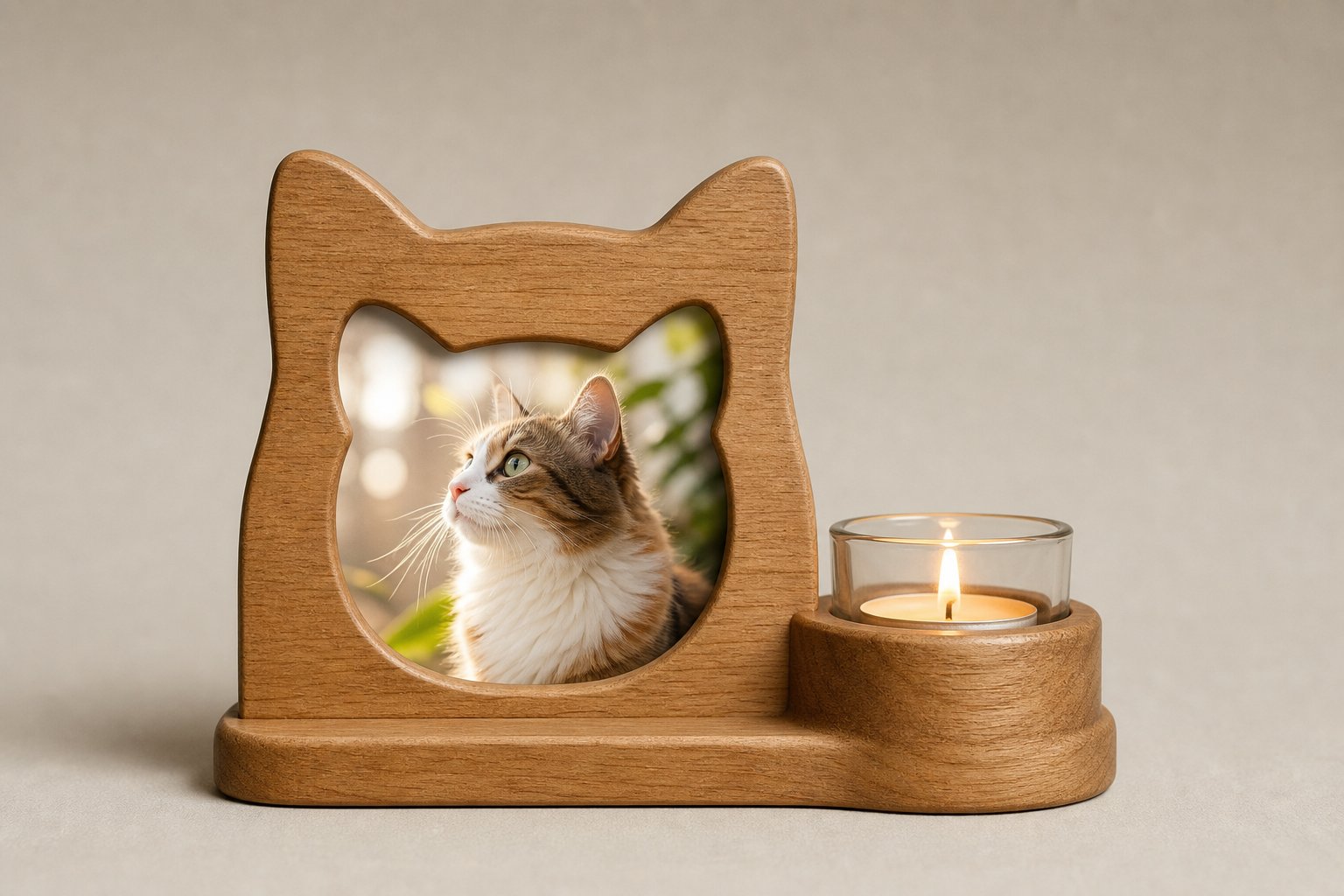
A memorial figurine — a sleeping cat, an angel dog, a small animal at rest — is often the piece that makes a customer stop scrolling. The material decides how that moment converts. Resin and ceramic look similar in a thumbnail, but they behave very differently in the hand, in transit and in your margin math. This guide gives buyers a practical way to read the two materials and to decide which role each should play in a catalog.
The two materials compared
| Dimension | Resin figurines | Ceramic figurines |
|---|---|---|
| Typical weight | Light; easy to handle and ship | Heavier; solid or hollow-fired clay with real heft |
| Detail and form | Undercuts, flowing poses, complex sculpture possible | Rounder, stable poses; fine detail carried by glaze and hand painting |
| Color and finish | Hand-painted acrylic, matte to satin | High-temperature glaze, glossy depth from the kiln |
| Breakage in transit | Low | Higher; needs fitted protective packing |
| FOB magnitude (varies with size and finish) | Roughly $2–10 | Roughly $2.5–9 and up for urn-grade pieces; figurines vary |
| Perceived value | Mid | Premium — weight and gloss read as value |
| Personalization | Painted names, attached plaques | Engraved bases, glaze colorways, hand-painted names |
| Best catalog role | Breadth SKUs, e-commerce range, gifts | Hero SKUs, clinic display, premium tiers |
How each material is made — and where
Ceramic figurines are shaped, glazed and fired at high temperature, with colorways tuned per glaze batch. The industrial base in China is deep: Jingdezhen's ceramic industry output passed 90 billion RMB for the first time in 2024, with ceramic product exports of 790 million RMB (China News Service network, 2025), while Chaozhou's ceramic exports passed 10 billion RMB for the first time in January–November 2024, up 21.3 percent (Chaozhou Customs via Chaozhou Daily, 2025). These clusters are why glaze customization and hand-painted decoration remain available at modest order quantities.
Resin figurines are cast from a sculpted master, cured, then hand-painted. Molding is what gives resin its strength: poses with extended tails, flowing fur or thin wings that would be fragile in clay hold up in resin. The craft sits inside the wider decorative-goods clusters of eastern China, where sculpting, molding and paint lines are mature and tooling costs for a new design are moderate — which is why new resin SKUs can be developed and tested quickly.
How customers perceive the two
Weight reads as value. A ceramic piece sets down with the gravity families associate with a permanent memorial, and a kiln glaze catches light in a way paint cannot fully copy. That is why 360iResearch's framework for the pet memorial products market — economy, mid-range and premium tiers within a market it sized at $445 million in 2025, growing to $820 million by 2032 (360iResearch, 2025) — maps naturally onto the material split: ceramic occupies the upper tiers, resin serves the entry and mid tiers with dignity. Photography amplifies the difference: glazed ceramic works beautifully against dark backdrops, while matte resin needs softer, diffused light to avoid looking flat.
Logistics and breakage reality
Resin ships well: light pieces tolerate parcel networks with basic protection. Ceramic is heavier and genuinely fragile, so packaging must do the work — individually fitted foam cavities, an inner box and a double-wall outer carton, aligned with the 125 cm drop-test expectation that marketplaces apply to fragile goods (Amazon Seller Central packaging requirements). With that packing standard and a piece-by-piece breakage policy behind it, ceramic remains entirely practical for e-commerce; without it, reviews will say so.
What to stock, by channel
- Online sellers: a resin base for breadth plus one or two ceramic heroes that anchor the premium tier.
- Vet clinics and aftercare providers: ceramic at the counter — its weight conveys solemnity in the hand — with resin covering budget-sensitive packages.
- Gift and sympathy retail: boxed resin sets with a card copy chosen for gifting moments.
FAQ
Which material looks better in product photos?
Both photograph well with the right light. Glazed ceramic favors directional light and dark backdrops; painted resin favors soft, diffused light and neutral backgrounds. Shoot both on white and on wood before committing to a listing style.
Can figurines be personalized?
Yes, on both materials: painted or engraved names, date plaques and paw motifs are standard OEM work. Ceramic adds glaze colorways and hand-painted detail; resin allows more sculptural personalization, such as a breed-specific pose.
Which survives shipping better?
Resin, mechanically. But ceramic packed to marketplace fragile-goods standards — fitted foam, inner box, double carton — reaches customers intact at consistent rates, backed by a piece-by-piece breakage policy.
What do typical units cost?
Magnitude ranges, not quotes: resin figurines run roughly $2–10 FOB and ceramic pieces roughly $2.5–9 and up, depending on size, glaze and decoration. Final prices vary with configuration and order quantity.
Sources & notes: China News Service network on Jingdezhen ceramics (2025); Chaozhou Customs via Chaozhou Daily on Chaozhou ceramic exports (2025); 360iResearch, Pet Memorial Products Market (2025); Amazon Seller Central fragile packaging requirements. FOB figures are magnitude ranges that vary with configuration, per PAWSANGEL product line specifications.
Want both materials sampled side by side?
We ship resin and ceramic samples in one parcel so you can compare weight, glaze and paint quality directly — reply within 12 business hours.