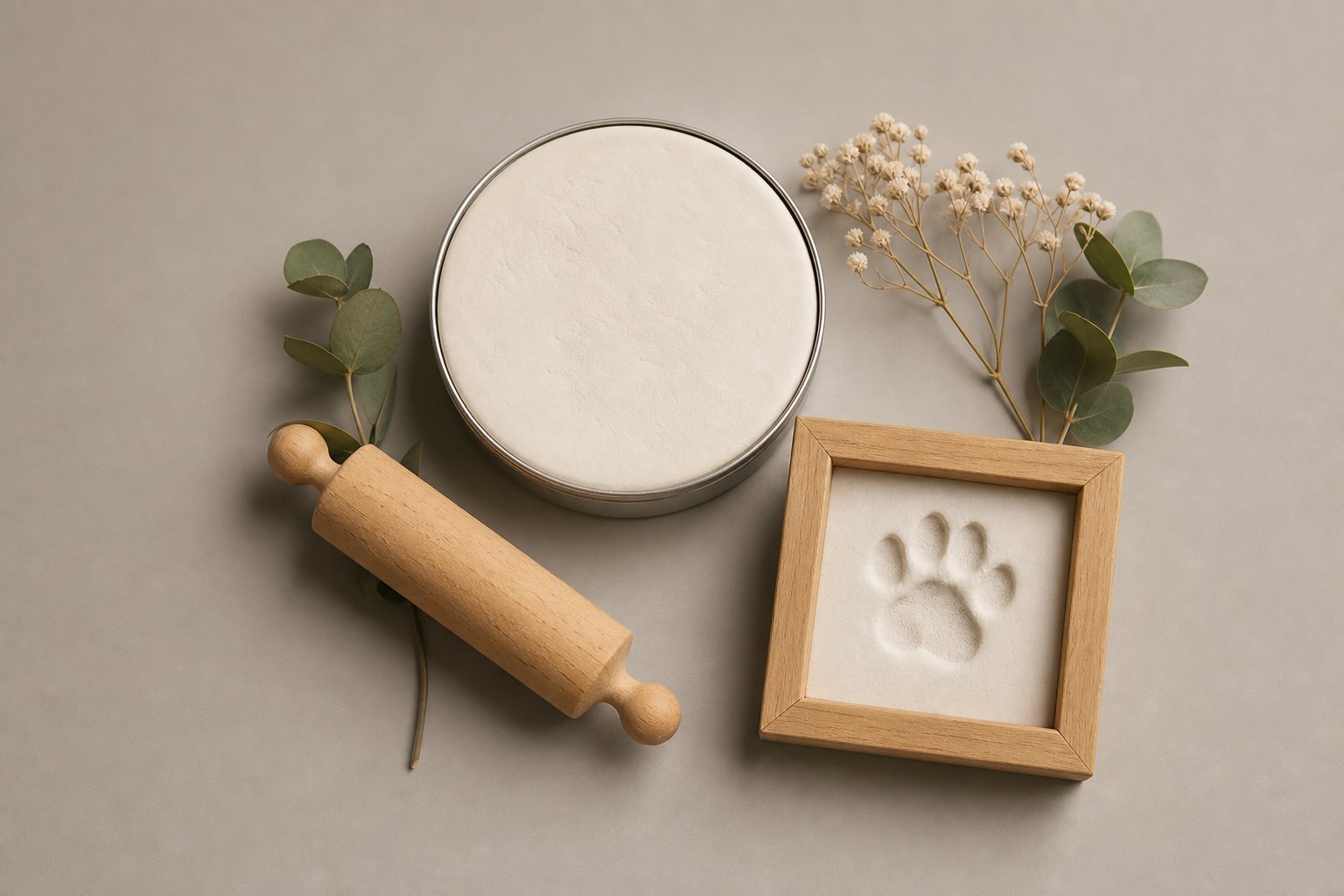
A paw print is the one impression that only this pet can leave, which is why paw print kits have become the entry product of nearly every serious memorial line: priced low, emotionally oversized, and usable at the exact moment a family needs something to do with their hands. They are also the product most tightly bound to time — which is why veterinary clinics, not only retailers, keep them within reach. This guide explains the three technologies inside the category, when each fits, what a retail-ready kit contains and how to brief an OEM supplier.
The three technologies
All paw print kits answer the same need — a lasting impression of the paw — but they do it with different materials, different effort levels and different keepsake results.
| Technology | How it works | Turnaround | What the family keeps |
|---|---|---|---|
| Clay impression | The paw is pressed into a soft, non-toxic clay slab, which air-dries hard at room temperature | Dries over 1–3 days | The impression itself — a sculptural keepsake, often framed or displayed on a stand |
| Ink pad print | The paw touches a pet-safe ink pad, then paper or card; the print is framed like artwork | Instant | A framed print; multiple copies possible for relatives |
| 3D plaster cast | A mold of the paw is taken, then filled with casting plaster | Mold same day, cast cures over days | A three-dimensional cast of the actual paw — the highest perceived value |
When each technology fits
Clay is the gentlest option for an elderly or frail pet: no ink touches the fur, the press takes seconds, and the result reads as a keepsake rather than a document. It is also the option that works both before a scheduled goodbye and shortly after a passing. Ink pads shine in two scenarios: "lifetime pawprint" promotions, where families record a print while the pet is healthy, and multi-copy situations, since a single session yields several prints for family members. The 3D plaster cast is the premium choice — it captures the actual geometry of the paw, pads and all — but it demands the most care in taking the mold, so it suits clinics and experienced groomers as much as home use.
What is inside a retail-ready kit
A complete kit removes every reason to hesitate at the moment of use. PAWSANGEL paw print kits combine the impression material — soft clay, ink pad or casting plaster — with an optional wooden display frame, and are sold as single units or gift sets. The standard components:
- Impression material in a sealed pouch — soft clay, pet-safe ink pad or two-part plaster, depending on the SKU.
- A rolling bag or smoothing card to flatten clay to an even thickness before pressing.
- A name-and-date tool for scratching the pet's name and dates into the clay before it dries.
- An instruction card with calm, step-by-step language — the copy matters as much as the contents (see the OEM section below).
- An optional wooden frame that turns the impression into a finished display piece with the pet's photo.
Commercially, the line is light to stock: single units or gift sets, MOQ from 200 pieces, and an indicative FOB band of roughly USD 1.5–6 depending on configuration. Gift-box and card-copy customization are standard OEM options, which is what turns a commodity kit into a brand product.
Briefing an OEM supplier: the details that decide quality
Three specification points separate professional kits from commodity ones. First, material safety: impression clay and ink should be non-toxic by formulation, and the safety claim should be written exactly as the formulation supports — no invented certifications. Second, card copy: instructions written for a grieving reader use short sentences, no exclamation marks and no cheerful language; have the copy localized for each market rather than machine-translated. Third, packaging logic: the kit must survive a parcel network with the clay pouch sealed and the frame corner-protected, so specify inner trays and a drop-test-compliant carton up front.
Where the category is heading
Personalization is one of the demand drivers named for the memorial products market by Grand View Research (2025), and the paw print is personalization in its purest form — the pet literally makes the artwork. The practical implication for buyers: kits pair naturally with frames, urns and sympathy cards, and clinics increasingly use them at appointments, which makes the kit the first physical touchpoint of the entire aftercare relationship. Treat it as a relationship product, not a SKU.
FAQ
Is the ink safe for the pet?
Pet-safe, non-toxic ink pads are the norm in the category, and a print takes only seconds — press, lift, wipe the paw with a damp cloth. The same applies to clay: it is a contact material by design, so non-toxic formulation belongs in the purchase specification, not in the marketing copy.
Can a print still be taken after the pet has passed?
Yes — both clay impressions and ink prints work after a passing, taken gently while the paw relaxes. This is a routine task for clinic staff, which is precisely why kits belong in examination rooms and not only on retail shelves.
The clay cracked while drying — what should customers be told?
Slow, even drying prevents most cracks: keep the slab at even thickness, dry it at room temperature away from heaters and direct sun, and avoid moving it during the first days. Small surface cracks can be smoothed with a fingertip while the clay is still leather-hard.
What are the MOQ and customization options?
PAWSANGEL paw print kits start from 200 pieces with an indicative FOB band of roughly USD 1.5–6 per kit depending on configuration. Gift boxes, instruction-card copy and frame finishes are all standard OEM options; engraved name plates can be added to framed versions.
Sources & notes: process descriptions and shelf-life handling follow industry common practice; the personalization demand driver is from Grand View Research (2025), Pet Funeral Services Market report coverage of memorial products; commercial specifications (MOQ, indicative FOB band) follow PAWSANGEL product specifications, stated as quantity bands that vary with configuration.
Need paw print kits for your clinic or store?
We quote clay, ink and 3D formats with your card copy and gift box from 200 pcs — reply within 12 business hours.