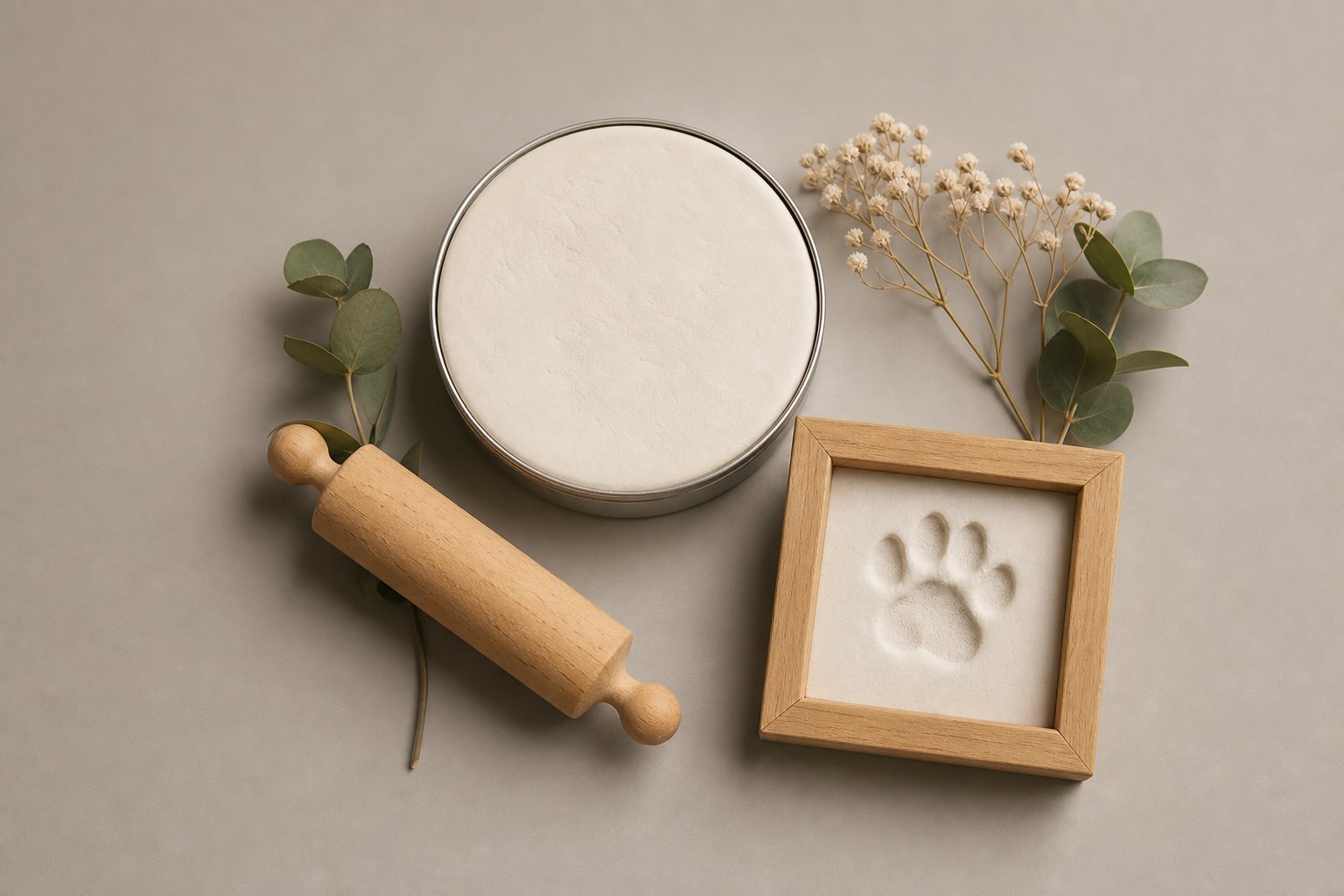
A paw print is the most personal mark a pet leaves, and kits that capture it cost little, ship light and emotionally complete almost any memorial purchase — which is why they appear as add-ons in every well-built memorial funnel. The category has two dominant formats: impression-clay kits and ink print kits. They look interchangeable in supplier catalogs and behave completely differently in a customer's hands. Here is how each works and how to position them so they raise the average order instead of cannibalizing each other.
The two kit types compared
| Dimension | Clay impression kits | Ink print kits |
|---|---|---|
| Output | A 3D pressed impression that air-dries hard | One or more flat prints on card |
| When it happens | At the clinic or at home, during aftercare | At the time of passing or the farewell visit |
| Skill and mess | Soft clay; press, level the edges, let it rest | Ink pad and card; one steady press |
| Retry friendly | Yes — clay can be re-kneaded before drying | Limited — extra cards included for a second try |
| Display | Frame or shadow box on a shelf | Sympathy card, certificate, framed print |
| FOB magnitude (varies with set) | Roughly $1.5–6 per kit | Similar range; lower for refill formats |
| Best catalog role | Gift kit, upsell beside urns and frames | Clinic supply, ceremony component, bundle part |
How clay impression kits work
A clay kit contains a portion of soft, air-dry clay — the non-toxic, stays-soft formulation is the industry norm — plus a rolling base and a frame or shadow box. The family or clinic staff presses the paw into the clay, levels the border, and the impression dries hard over a day or two. Two properties decide whether customers love these kits: softness (an elderly or light-boned paw must leave a readable print with gentle pressure) and open time (how long the clay accepts a redo before curing). Because the result is an object, clay kits photograph beautifully next to urns and frames, which is exactly where they upsell best.
How ink print kits work
An ink kit pairs a clean-touch ink pad with heavyweight cards. The paw touches the pad surface — or the pad is pressed to the paw, depending on design — and transfers a detailed flat print without ink residue on the fur. Multiple cards mean multiple prints: one for the family, one for the clinic file, one for a frame. Prints slot into sympathy cards and certificates, which makes ink the format of choice at the moment of passing, when clinics and aftercare providers want a complete, orderly record. It is also a common industry practice for clinics to take prints of pets still in their care as part of senior-pet programs — a gentle on-ramp to the whole category.
Where each format sells
- Clinics and aftercare providers: ink pads at the farewell, clay kits offered as the take-home keepsake.
- Online and DTC sellers: clay gift kits beside urns and photo frames; ink refills as low-ticket basket fillers.
- Bundles: a farewell set — ink print, fur vial, candle and card — or a home set of clay kit plus frame. Bundling raises the order without raising the grief load; personalization remains a category-wide demand driver (Grand View Research, 2025).
Quality checks before you order
Clay: request softness and open-time specs, and test with the lightest realistic paw pressure. Ink: ask for the ink type (smudge-resistant, acid-free formulations are the norm) and card weight that will not buckle. Frames: check backing and mounting so the keepsake sits secure. Instructions: pictorial, language-free steps prevent most failures — and if you sell in one language market, OEM card copy is a small customization with an outsized effect. Our paw print line runs from single kits to gift sets at MOQ 200 pcs, with card wording and gift boxes customizable.
FAQ
Can a paw print be taken after burial or cremation?
No. Both formats capture the paw itself, so the window closes at burial or cremation. That urgency is exactly why clinics keep ink pads on hand — the record is made at the right moment, not later.
Which format is easier for families at home?
Clay kits are the more forgiving: the impression can be re-kneaded and retried before drying, while an ink print is generally a one-press outcome. Both succeed when the instructions are pictorial and unhurried.
Can we private-label the kits?
Yes — card copy, box design and frame finishes are standard OEM options on our line, which starts at 200 pieces per set configuration. Language-specific instruction cards are a common first customization.
What about fur keepsakes as a third format?
Fur vials complement rather than compete: an ink print records the farewell, clay keeps the shape, fur preserves a material piece. Together they form the farewell sets that lift basket size with genuine usefulness.
Sources & notes: kit typologies, material formulations and quality checks reflect PAWSANGEL product specifications and common industry practice; the personalization-demand context references Grand View Research (2025). FOB figures are magnitude ranges that vary with set configuration.
Not sure which kit your channel needs?
Tell us where you sell — clinic, marketplace or gift retail — and we will propose a kit mix with sample configurations in one parcel.