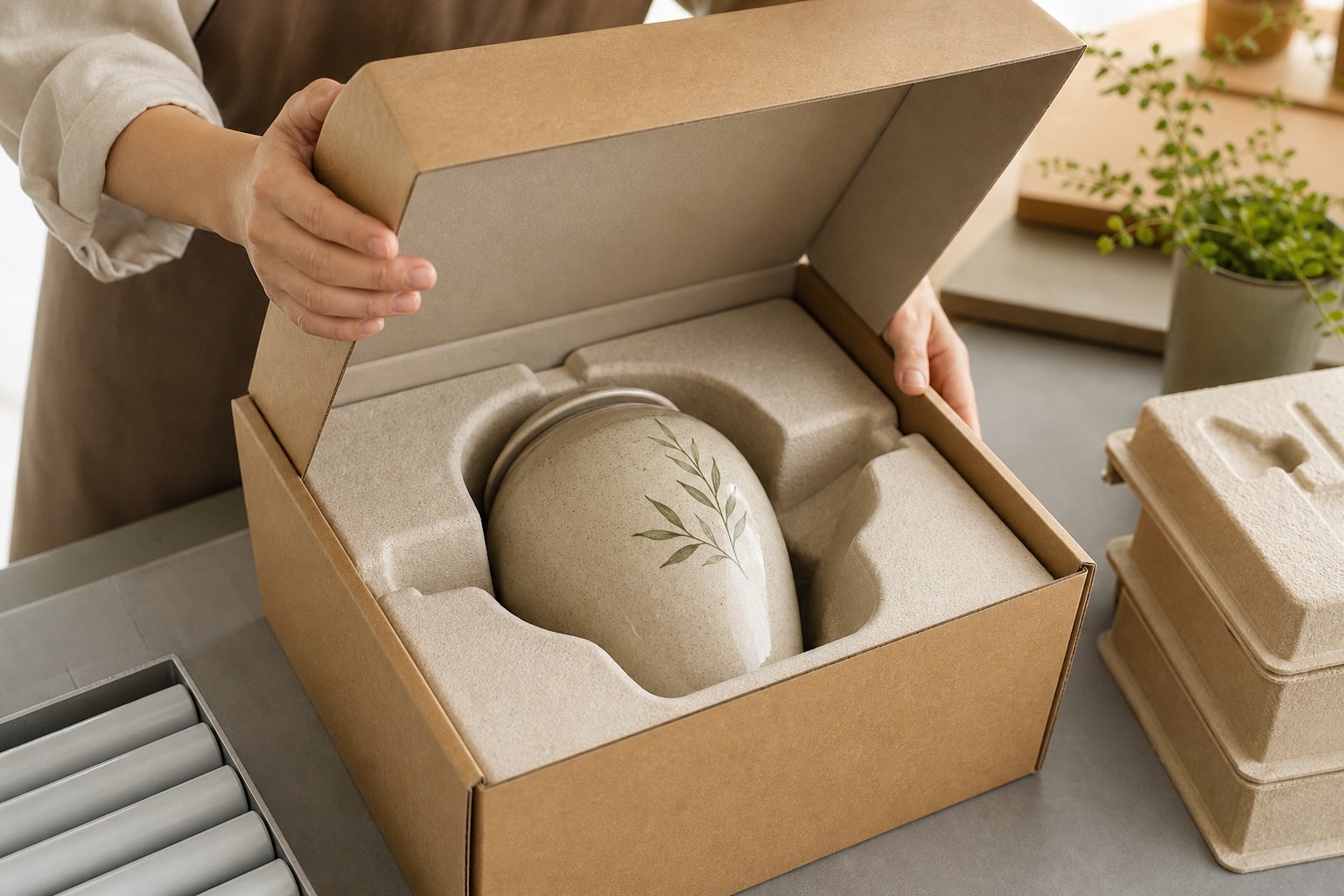
Packaging in this category does two jobs at once: it has to survive freight, and it has to arrive at a house where someone is grieving. Ceramics, crystal and stone urns are fragile in the literal sense; the moment of unboxing is fragile in a different sense. A good packaging design treats both as engineering problems with a checklist, not as afterthoughts solved with more bubble wrap.
The outer carton: built for freight, not for shelf
The outer box should look like ordinary freight — no bright branding, no cheerful mascots, no printed product photos. Reviewers in this category repeatedly mention discreet exteriors as a positive; a loud branded box outside a home where a pet has just died reads as tone-deaf before it is even opened. For fragile lines (ceramics, crystal, stone), our packaging standard follows a 125cm drop-test benchmark aligned with the packaging guidance used by major e-commerce platforms for fragile goods, with individually cushioned inner cavities and a double-wall outer structure.
The inner box: this is the unboxing moment
Inside, the tone can shift. A simple lined gift box, tissue paper in a neutral tone, and — where the brand chooses to include one — a short printed sympathy card set a different register than the shipping carton. Nothing here needs to be expensive; it needs to be quiet and deliberate. Avoid glossy "celebration" ribbon stock or anything that visually reads as gift-for-an-occasion packaging.
Packaging design checklist
| Layer | Function | Design rule |
|---|---|---|
| Outer carton | Freight protection, discretion | Plain kraft or white, no product imagery, double-wall for fragile SKUs |
| Cushioning | Survive a 125cm drop | Individually cushioned cavity per unit, not loose fill only |
| Inner box | Unboxing experience | Matte, neutral tone, no occasion-style ribbon |
| Insert card | Emotional tone-setting | Short, plain wording; optional, never pushy upsell copy |
| Labeling | Compliance and handling | Fragile marks, this-side-up, no promotional stickers on the parcel |
What not to do
- Do not print "SALE" or discount stickers anywhere on the shipping carton.
- Do not use bright primary-color ribbon or seasonal gift wrap patterns.
- Do not rely on loose fill alone for ceramic, crystal or stone items — use individually shaped cushioning.
- Do not omit fragile handling labels to save cost; breakage costs more in trust than the label costs in materials.
FAQ
Does discreet packaging cost more than branded packaging?
Not necessarily — plain kraft stock is often cheaper than full-color printed cartons. The cost difference, if any, usually sits in the inner box and insert card, which are small compared to the product itself.
Should the outer box mention what's inside?
No. Keep the outer carton generic. Anyone handling the parcel in transit — a neighbor, a front-desk, a delivery locker — should not be able to tell its contents.
What drop-test standard should we design to?
We design fragile-line packaging to a 125cm drop-test benchmark, consistent with fragile-goods packaging guidance used by major e-commerce platforms; see our drop test standards article for the full method.
Can we add a discount code in the insert?
We recommend against it for first orders in this category. A quiet card that simply says thank you performs better with reviewers than one that pushes a repeat-purchase discount.
Sources & notes: fragile-goods drop-test and packaging guidance references major e-commerce platform seller requirements for fragile goods; specific packaging policies described follow PAWSANGEL published standards.
Need packaging specced for a new SKU?
Tell us the material and we will propose an outer/inner packaging structure and drop-test plan before tooling starts.