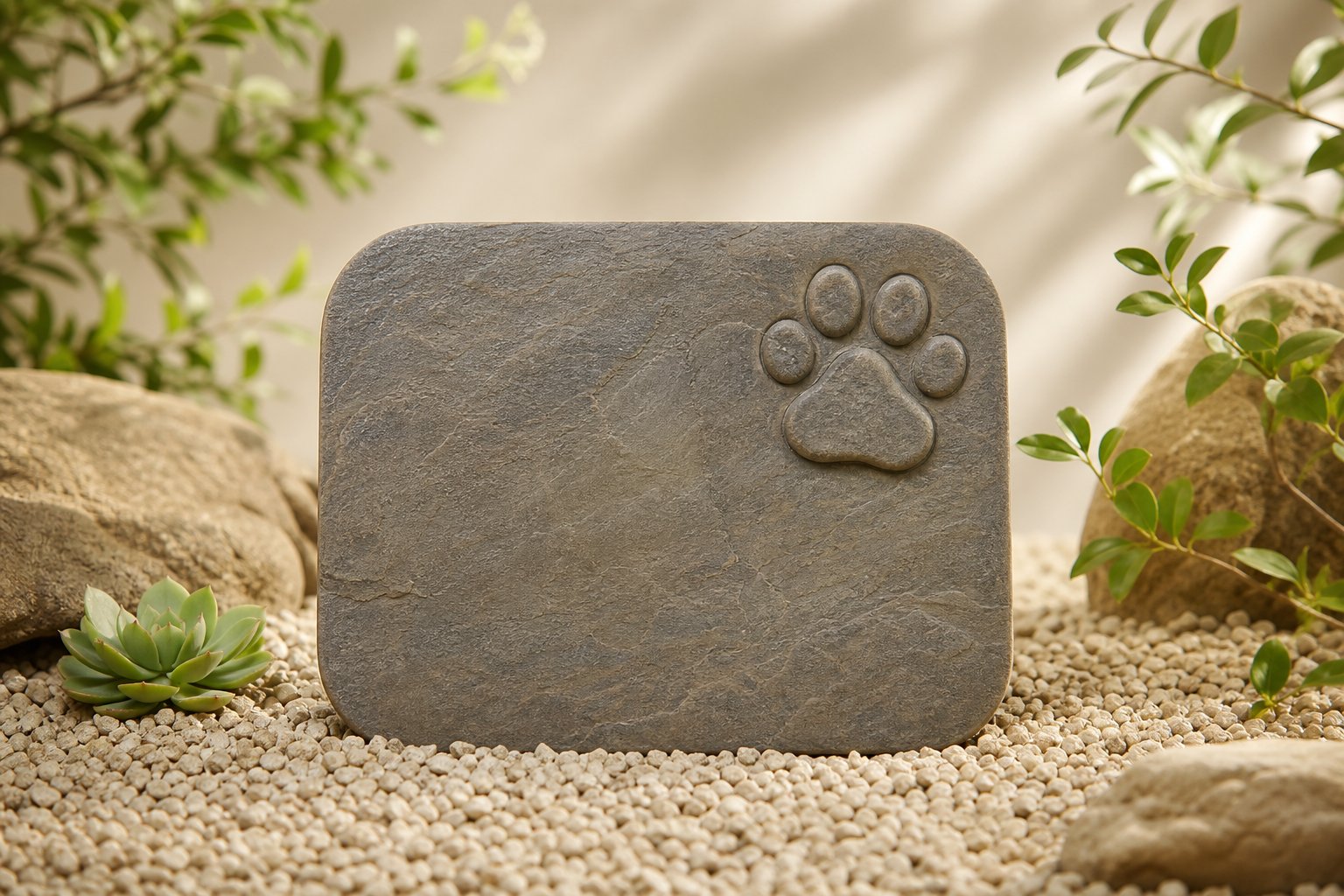
Some families want to keep a pet close at home; others want somewhere to go. Memorial stones and memorial benches serve that second need — a fixed place in a garden, yard or cemetery — but they are different products in scale, freight behavior, price tier and even buyer type. Retailers who treat them as one "outdoor memorial" category tend to underprice the bench and overstock the wrong stones. This guide separates the two cleanly and shows how they sell together.
The two formats compared
| Dimension | Memorial stones | Memorial benches |
|---|---|---|
| Scale | Hand-held plaques and rocks, typically 15–30 cm | Seat-height garden furniture footprint |
| Price tier | Accessible; engraving and stone type drive the tier | Premium ticket; specified per project |
| Freight profile | Parcel networks with protective packing | Oversized freight; often flat-pack or local fulfillment |
| Personalization | Engraved name, dates, verse, paw motif | Engraved plaque, carved beam or seat panel |
| Typical buyer | Families — gardens, yards, grave markers | Pet cemeteries, memorial gardens, vet clinics, institutions |
| Best scenario | A marker at the resting place or a garden focal point | A place to sit and remember, for many visitors |
Memorial stones: the personal-scale workhorse
Stones carry the category's volume because they solve the most common wish: a name, at a place, in a material that lasts. Slate, granite and river rock each behave differently — slate takes crisp laser-contrast engraving, granite reads formal and monumental, river rock brings a softer, natural shape — and our line spans five sizes from 15 to 30 cm so tiers stay clear. The craft base matters for quality claims: Huian county in Fujian, designated a World Craft City for stone carving by the World Crafts Council in 2015 (Quanzhou municipal government), anchors deep carving capacity. Placement rules vary by market, and a good product page says so: in the US, backyard burial is governed state by state; Germany generally permits burial on one's own land with 50–80 cm of cover; the Netherlands allows it in one's own garden at roughly one meter's depth; France reserves pet cemeteries to public institutions and discourages home burial (service-public.fr). Even where burial is restricted, stones still serve as symbolic markers and indoor displays — which is why they remain the category's dependable seller.
Memorial benches: the destination piece
Benches answer a different need: not a marker but a place. They belong where people gather — cemetery plots, memorial gardens, the grounds of veterinary clinics — and they are bought by institutions as often as by families. The institutional base is real: Germany counts around 120 pet cemeteries (figures of the German pet funeral association, cited by German media), and the United States has had dedicated pet cemeteries for well over a century — New York's Hartsdale Pet Cemetery, established in 1896, is widely described as the oldest continuously operating pet cemetery in the country. Places like these need seating; a bench with an engraved plaque becomes both infrastructure and memorial. Operationally, benches are a quote business: dimensions, material (carved stone versus cast or wooden frames), engraving content and installation all get specified per project, which suits suppliers with OEM depth and honest lead times.
How the two sell together
- Family funnel: stone first, then garden additions — solar lights, stepping stones, wind chimes — that turn one marker into a small memorial corner.
- Institutional funnel: benches anchor a project, then stones, plaques and planters fill the surrounding space on the same engraving standard.
- Seasonal rhythm: garden season peaks in spring and summer; National Pet Memorial Day — the second Sunday of September, established in 1972 by the International Association of Pet Cemeteries and Crematories — is the category's shared content moment for both formats.
Range-building advice
Stock stones across three tiers — plain river rock, engraved slate, premium granite — and keep every tier parcel-shippable with fitted foam and double cartons, the packing standard that marketplaces expect for fragile goods. Carry one or two bench specifications as quotable references rather than shelf stock, and quote them with engraving proofs and realistic lead times. This structure lets stones carry cash flow while benches lift project revenue — and it mirrors how cemeteries and clinics actually buy.
FAQ
Do families need permission to place a memorial bench?
On their own property, no. In cemeteries, parks and public spaces, the operator's rules govern — bench programs sold to institutions should assume the buyer is the permission.
Which format sells better online?
Stones, clearly — they fit parcel logistics and impulse-worthy price points. Benches convert through quote flows, project conversations and B2B channels rather than the cart page.
How are memorial stones shipped safely?
Individually fitted foam cavities, an inner box and a double-wall outer carton, aligned with the drop-test expectations marketplaces apply to fragile goods; breakage on arrival is compensated piece by piece against photos.
Can benches be personalized?
Yes — engraved plaques, carved beams and seat-panel text are standard. We provide engraving proofs before production, and engraving samples run in 3–5 days on our workflow.
Sources & notes: Quanzhou municipal government record of Huian's World Craft City designation (2015); German pet funeral association figures via German media on pet cemetery counts; Hartsdale Pet Cemetery founding widely published (established 1896); service-public.fr on French rules (1976 law); International Association of Pet Cemeteries and Crematories on National Pet Memorial Day. Size tiers and packing standards follow PAWSANGEL product specifications.
Quoting a memorial garden or clinic project?
Send us the site type and engraving content; we will return bench and stone specifications with proofs and lead times — reply within 12 business hours.