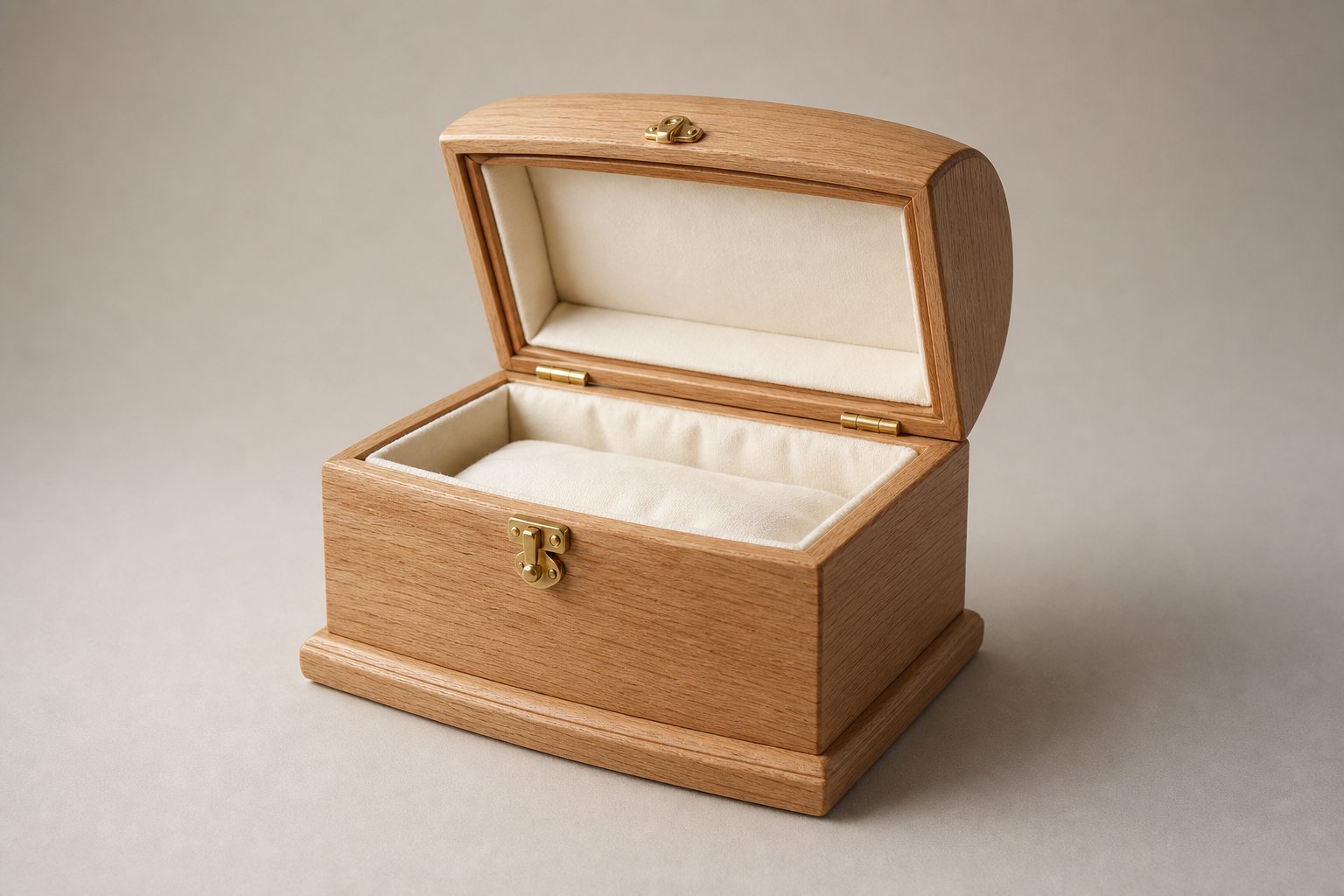
The casket question looks like a materials question, but it is really a service-design question. Cardboard and wooden pet caskets exist because aftercare providers need two different things from the same object: an affordable, dignified vessel for a pet whose ceremony is brief, and a presentation piece worthy of being kept. Choosing between them is really deciding how your good/better range is built — and both belong in most catalogs.
The comparison
| Dimension | Cardboard caskets | Wooden caskets |
|---|---|---|
| Cost tier | Entry tier; the budget-friendly option in the pet casket line (FOB magnitude roughly USD 4-18 across the line, by size and material) | Mid tier and up; solid presentation justifies the step up |
| Weight and shipping | Very light; ships flat; negligible freight impact; stock deep without cost penalty | Light woods such as paulownia keep weight low; panel designs can flat-pack |
| Ceremony presentation | Clean and simple; presentation depends on lining and drape | Warm, substantial; reads as a piece of furniture in the farewell room |
| Customization | Printed motifs and personalized cards; limited to surface | Laser engraving, viewing window, lining color, name plate |
| After the ceremony | Not intended to be kept; a respectful vessel for the pet | Can be retained, engraved, or repurposed as a memorial box |
| Environmental angle | Recyclable board; credible eco story when sourced responsibly | Natural timber; willow versions extend the line into fully plant-based territory |
| Typical buyer | Clinics and services covering communal-cremation budgets; bulk stocking | Memorial retailers, funeral providers offering private services |
Culture decides more than either material
The strongest argument for stocking both lines comes from looking at Japan. The custom there is to cremate the pet together with the casket — the vessel is part of the farewell, not a keepsake. That is precisely the brief light paulownia wood was chosen for across generations of casket making: easy to burn, light to carry, dignified in appearance. An estimated 60 to 70 percent of coffins used in Japan are supplied from the Caozhou cluster in Shandong, China (Japanese Consulate-General in Qingdao, 2024, citing company figures) — a supply chain built on exactly this material logic.
Western markets weigh the same trade-off differently: where the family keeps ashes at home, the casket is a stage in the ritual, and either material serves — the choice becomes about the ceremony the provider is selling. Where burial is chosen, wood or willow aligns with ground interment, and our pet casket line covers body sizes from small pets up to 40 kg in four tiers.
What to check before ordering either
- Load rating and interior dimensions. Ask for the tested body-weight range per size, not just outer dimensions; a casket that sags is a ceremony failure.
- Lining and interior finish. The fabric is most of what the family actually sees. Soft natural linings read dignified in both materials.
- Assembly and storage. Flat-packed formats save clinic storage space; verify assembly is tool-free and takes under a minute.
- Cremation compatibility. Light timbers such as paulownia are chosen for their burning behavior; confirm any finishes with the cremation provider if the casket will enter the chamber.
- Wood packaging compliance. Wooden export packing follows ISPM15 heat treatment with the IPPC mark applied by approved facilities — standard practice on our wood lines.
Building the good/better ladder
- Lead with cardboard for volume and empathy. It lets a clinic or service say yes to every family's budget without a cheaper-feeling conversation — dignity is carried by the lining and the farewell script, not the price.
- Offer wood as the deliberate upgrade. Families arranging a private service or intending to keep the vessel will self-select upward when the upgrade is framed as permanence, not expense.
- Complete the ladder with willow. Woven natural caskets serve the eco segment with the same ceremony value as wood — see our biodegradable casket guide.
- Pair every casket sale with an urn conversation. After cremation the family needs somewhere for the ashes; the casket is the natural opening for that casket-versus-urn discussion.
FAQ
Is a cardboard casket dignified enough for a farewell?
With a soft lining and a considered setting, yes — dignity at a farewell comes from the ritual, the words and the care of the people present, not the price of the vessel. Providers commonly drape and personalize cardboard caskets precisely for this reason.
Do cremation providers accept wooden caskets?
Light, fast-burning timbers such as paulownia are the traditional choice where the casket is cremated with the pet — the practice behind Japan's casket custom. Individual providers set their own requirements, so confirm finishes and fittings with the local chamber operator when in doubt.
Which tier suits a 30 kg dog?
Both lines cover it: the casket range runs in four body-size tiers up to 40 kg. Choose cardboard for budget-led services and wood where the family wants a piece to keep or bury — capacity is identical, so let intent decide.
Can wooden caskets be personalized?
Yes — laser engraving of names and dates, viewing windows, lining colors and name plates are all standard options. Cardboard personalizes through printed motifs and accompanying cards.
Sources & notes: Japanese Consulate-General in Qingdao (2024) on paulownia casket supply from the Caozhou cluster and cremation-with-casket custom, citing company figures; casket sizing tiers and material range follow PAWSANGEL pet casket line specifications (FOB magnitudes vary with size and configuration); ISPM15/IPPC wood-packaging practice per customs-approved treatment facilities. Ceremony-use conventions described as industry common practice.
Designing a good/better casket ladder for your service?
Send us your body-size tiers and ceremony formats; we configure cardboard, wood and willow options with samples — reply within 12 business hours.